

How Long Do You Have to Work With Concrete?
Working time is the window between when you pour concrete and when it stiffens enough that you can no longer finish, level, or adjust it. For standard concrete at 70°F, that window is roughly 30–90 minutes. But temperature, humidity, wind, and the type of mix can cut that window in half — or double it. This guide explains what affects working time and how to plan your project around it.
For standard concrete at 70°F, that window is roughly 30–90 minutes. But temperature, humidity, wind, and the type of mix can cut that window in half — or double it.
Three Stages You Need to Know
People often confuse "setting," "drying," and "curing." Here's what they actually mean:
Initial set — When concrete transitions from plastic (workable) to rigid. This is the end of your working window. Once initial set occurs, you cannot meaningfully finish, float, or adjust the concrete without damaging it.
Final set — When the concrete is completely stiff throughout. Typically 4–8 hours after the pour. The slab will feel hard but lacks meaningful strength yet.
Cure — The 28-day process of strength development through the hydration reaction. For more on the chemistry, see does concrete dry or cure.
Your job as the person pouring is to plan the entire pour, screeding, floating, edging, and broom finishing sequence so it all happens before initial set.
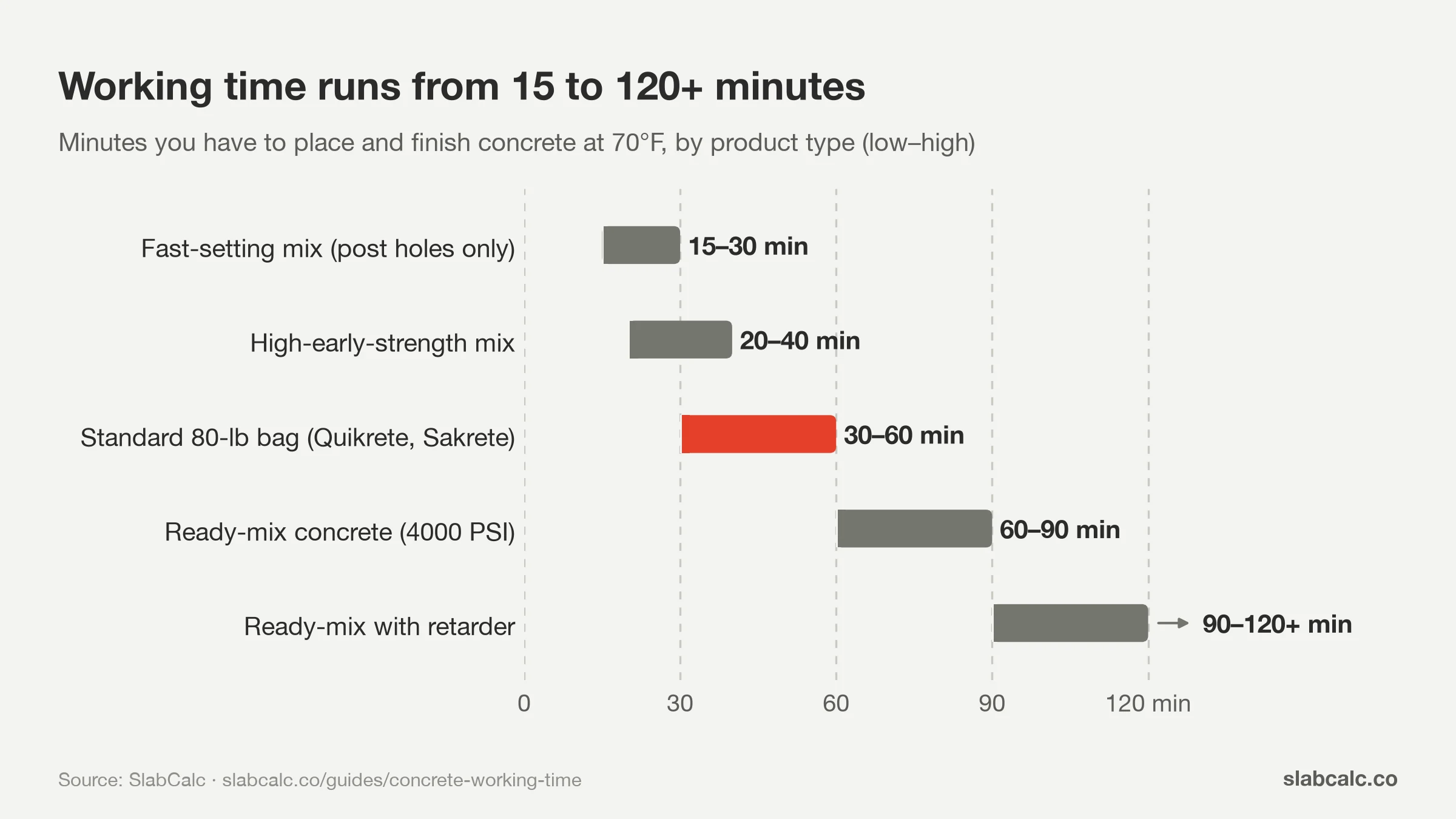
Working Time by Product Type
| Product | Working Time at 70°F | Notes |
|---|---|---|
| Standard 80-lb bag (Quikrete, Sakrete) | 30–60 minutes | Most common; plenty of time for small pours |
| High-early-strength mix | 20–40 minutes | Sets faster; reaches strength sooner |
| Fast-setting mix (Quikrete Fast-Set) | 15–30 minutes | Post holes only; too fast for slabs |
| Ready-mix concrete (4000 PSI) | 60–90 minutes | From truck; more time due to retarders |
| Ready-mix with retarder | 90–120+ minutes | For large pours or hot weather |
How Temperature Affects Your Window
Temperature is the single biggest variable that changes working time.
| Temperature | Effect on Working Time |
|---|---|
| 90°F+ | 15–20 minutes shorter than at 70°F; can be critically short |
| 80°F | 10–15 minutes shorter |
| 70°F | Standard baseline; bag label times apply |
| 60°F | 15–30 minutes longer |
| 50°F | 30–60 minutes longer |
| Below 40°F | Working time extends significantly, but curing slows dangerously |
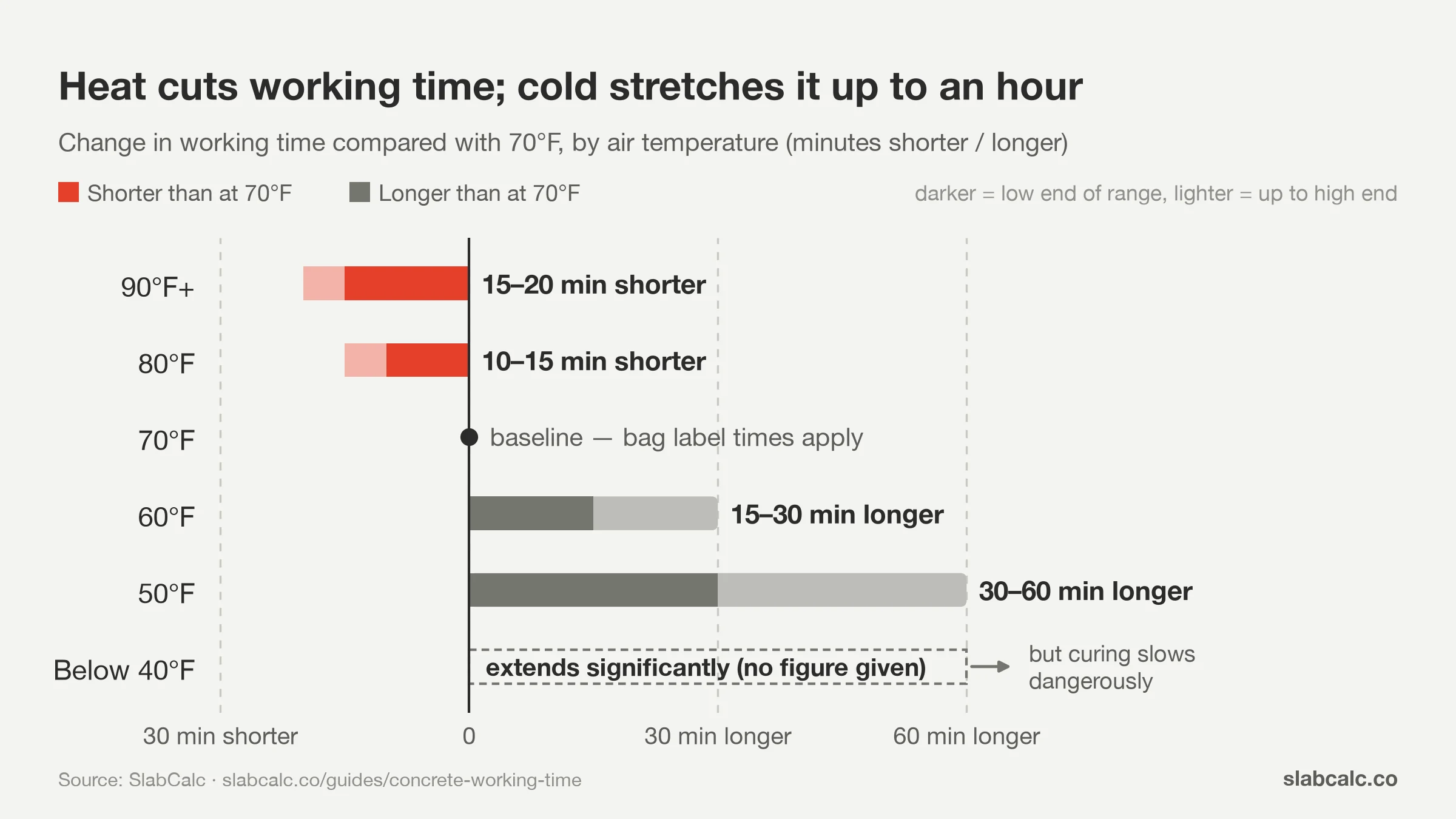
On a 95°F day, a mix that normally gives you 60 minutes might stiffen in 40. Plan accordingly. For more on temperature and pour timing, see best time to pour concrete.
How Wind and Humidity Affect the Surface
High wind and low humidity accelerate surface evaporation. Even if the interior concrete still has working time, the surface can develop a thin, dry crust that:
- Resists float work and smears instead of smooths
- Creates weak, peel-prone surface layer
- Shows trowel drag marks
Signs the surface is drying too fast:
- Surface looks lighter/whitish compared to the interior
- Float drags or pulls instead of smoothing
- Concrete resists the broom when you're trying to finish
If you see these signs, mist the surface lightly with water and continue working quickly. Don't overdo it — too much water weakens the surface.
Finishing Sequence — Don't Waste Time
The key to managing working time is knowing the sequence so you're not redoing steps or losing time to confusion. Here's the order:
- Pour — dump and spread concrete roughly
- Screed — drag a straight board across the forms to level
- Bull float (large slabs) — initial smoothing pass to close the surface
- Wait — let bleed water evaporate from the surface (don't work wet concrete)
- Edge — run edger along all form edges
- Float — magnesium float for surface smoothing
- Broom finish — while still workable but firm enough to hold texture
Step 4 (waiting for bleed water) is where new pourers often lose time — they rush to float before the bleed water clears and get a weak, wavy surface. See concrete finishing timing for the full guide on reading the surface.
Signs Concrete Is Getting Too Stiff to Work
- A handful cracks when squeezed rather than holding shape
- The float leaves ridges that don't smooth out
- Pressing your thumb 1/4 inch into the surface requires significant force
- Footprints no longer leave clean impressions
When you see these signs, stop working the concrete. Continuing to trowel over stiff concrete will cause surface tearing that weakens the final product. Accept what you have and move on to curing.
Planning Your Pour Around Working Time
For any project, estimate the total working time needed:
- Small slab (50 sq ft or less): 30 minutes typically sufficient
- Medium slab (50–200 sq ft): 45–60 minutes needed
- Large slab (200+ sq ft): Order ready-mix with retarder, or plan to pour in sections
If your project requires more than 60 minutes of working time, ordering ready-mix concrete with a retarder admixture is more reliable than trying to stretch bagged concrete.
Related Guides
- How to Finish Concrete — The screed-float-broom sequence in detail
- Concrete Finishing Timing Guide — How to read the surface and time each finishing step
- Best Time to Pour Concrete — Temperature and weather planning