

Settlement Cracking in Concrete: Identification, Repair & Prevention Guide
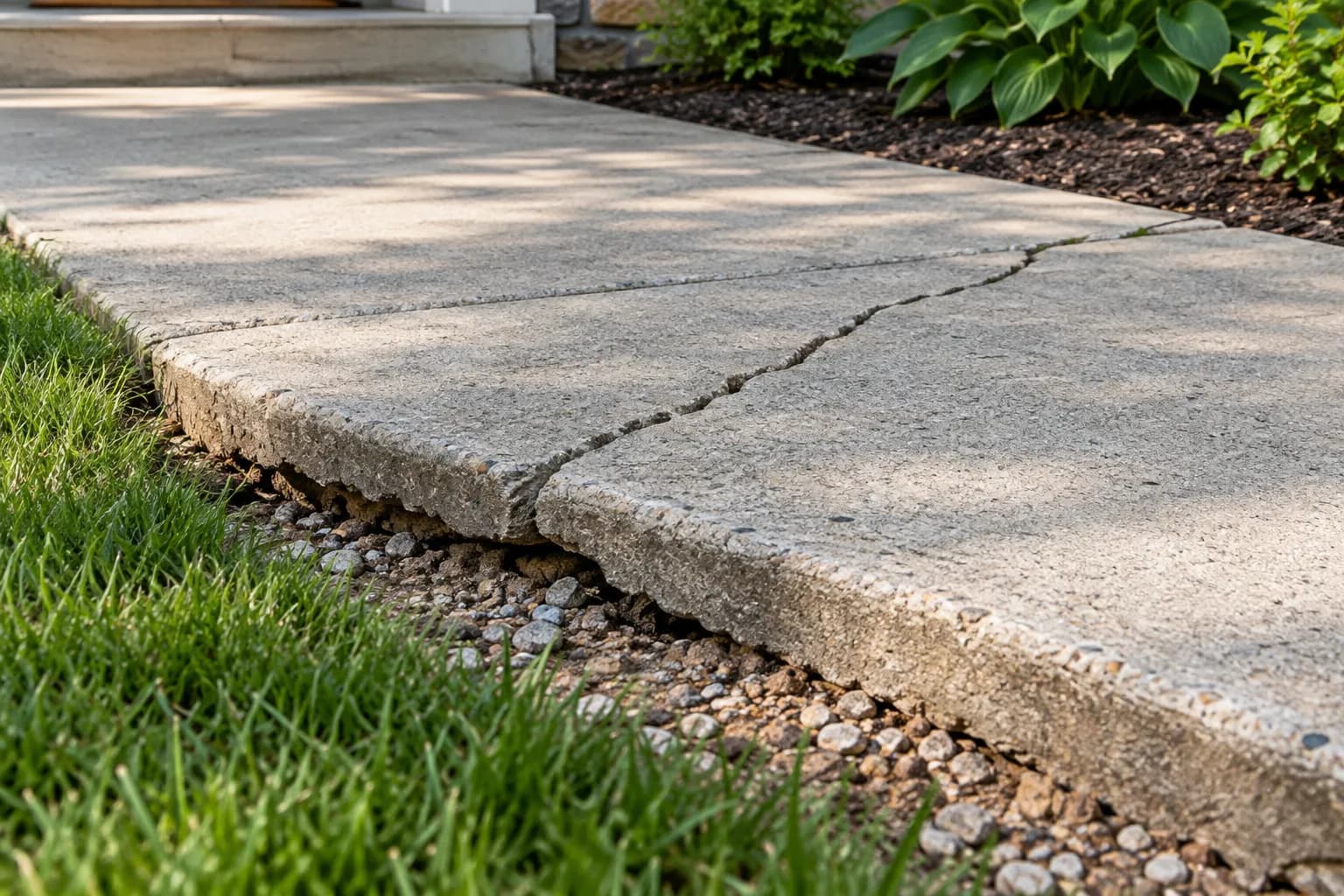
Settlement cracking occurs when the soil beneath a concrete slab loses its load-bearing capacity, causing one or more sections to sink relative to adjacent concrete. The hallmark sign is a visible step difference at the crack — one side sits measurably lower than the other. Settlement affects driveways, sidewalks, patios, garage floors, and foundations, with repair costs ranging from $500 for foam lifting a single slab panel to $10,000+ for foundation underpinning.
What Is Settlement Cracking?
Settlement cracking is the fracture of a concrete slab caused by downward movement of the supporting soil, resulting in one or more slab sections dropping below the original grade. Unlike every other crack type in concrete, settlement cracks are defined by vertical displacement — one side of the crack sits measurably lower than the other, creating a step that you can feel underfoot and measure with a straightedge. The displacement can range from a barely perceptible 1/8 inch to several inches in severe cases.
The mechanism is simple: concrete is strong in compression (3,000–5,000 PSI for residential mixes) but weak in tension (roughly 10% of compressive strength, or 300–500 PSI). A standard 4-inch residential slab weighs approximately 50 pounds per square foot — about 150 lbs/ft cubed for normal-weight concrete. When the soil beneath a section loses its bearing capacity and a void forms, the slab must span the void like a bridge. If the void exceeds the slab's ability to span it in flexure, the concrete cracks at the void edge and the unsupported section drops into the void under its own dead weight, plus any applied loads.
ACI 360R ("Design of Slabs-on-Ground") addresses settlement as a subgrade support failure. The document emphasizes that slab-on-ground performance depends as much on the quality of the supporting soil as on the concrete itself. A perfectly designed 4,000 PSI slab will still crack and settle if placed on uncompacted fill, over organic material, or on soil subject to erosion.
Settlement cracking is fundamentally different from the other major crack types. Shrinkage cracks show no vertical displacement — both sides of the crack remain at the same elevation because the movement is horizontal contraction, not vertical sinking. Structural cracks from overloading may show displacement, but the displacement is caused by bending failure under applied load (a heavy vehicle, for instance), not by soil movement. Frost heave cracks involve upward displacement where freezing soil pushes sections of the slab up rather than allowing them to drop. Settlement is specifically downward movement caused by loss of soil support.
What Causes Settlement Cracking?
Settlement cracking traces back to one root issue: the soil beneath the slab can no longer support the load above it. Five distinct mechanisms account for virtually all residential and commercial settlement, and understanding which one is active determines whether the repair will last.
Inadequate Soil Compaction
Fill soil that is not properly compacted before the concrete pour is the most preventable cause of settlement. When a building site is graded, excavated soil is often pushed back into low areas and loosely placed to achieve the desired elevation. This fill may have a density of only 70–80% of its maximum achievable density. Over time, the weight of the concrete slab, traffic loads, and moisture cycling compress this loose fill, and the slab above settles downward.
The engineering standard for compaction is 95% of Standard Proctor density, as defined by ASTM D698. This test determines the maximum dry density achievable for a given soil at its optimum moisture content. Every inch of depth of improperly compacted fill can settle 1/4 to 1/2 inch over time. A 12-inch-deep zone of poorly compacted fill can therefore produce 3 to 6 inches of settlement — enough to cause catastrophic cracking and a completely non-functional slab.
Compaction must be achieved in lifts — typically 6 to 8 inches of loose fill compacted to the required density, then another lift placed and compacted on top. Compacting a 2-foot depth of fill all at once with a plate compactor does not work; the compactive energy dissipates within the top several inches and the material below remains loose.
Water Erosion and Washout
Water is the single most common cause of settlement cracking in residential concrete — responsible for an estimated 80% or more of cases. The mechanism involves water flowing beneath the slab, carrying soil particles with it, and creating progressively larger void spaces.
The most frequent scenario is a gutter downspout that discharges directly adjacent to a concrete slab. Roof runoff concentrates at the downspout outlet and saturates the soil next to the slab edge. Over months and years, the flowing water erodes fine soil particles from beneath the slab, washing them away along the natural drainage gradient. The void starts small — perhaps the size of a fist — and grows with every rainstorm until it undermines enough of the slab to cause cracking and settlement.
Poor site grading compounds the problem. If the ground surface slopes toward the slab rather than away from it, surface water drains against the slab edge and percolates beneath it. The International Residential Code (IRC) Section R401.3 requires a minimum grade of 6 inches of fall within the first 10 feet from the foundation — a slope of approximately 5%. Many existing homes have settled landscaping, added mulch beds, or regraded areas that no longer meet this standard.
Underground water flow from broken irrigation lines, leaking water service pipes, or natural seepage also causes washout. These sources are harder to diagnose because the water flow is not visible at the surface. Clues include consistently wet or soft soil adjacent to the settled area, or settlement that continues even during dry periods.
Organic Decomposition
Buried organic material — tree roots, stumps, wood debris, vegetation, and topsoil — decomposes over time and leaves void spaces beneath the slab. This process is slow, typically occurring over 5 to 15 years depending on the material and soil conditions, which is why decomposition-related settlement often appears long after construction.
Tree stumps are the worst offenders. A 12-inch-diameter stump left in the ground during site preparation occupies over 100 cubic inches per inch of depth. As the wood decomposes, it collapses inward, creating a concentrated void that the slab above eventually settles into. The settlement pattern is characteristically localized — a circular or irregular depression directly over the decomposing material, rather than the linear or edge-following pattern typical of water erosion.
Building codes require the removal of organic material from beneath slabs (IRC R506.1 requires a base of "clean graded sand, gravel, crusite stone, or slag"), but enforcement varies and debris from construction activities (wood scraps, form lumber, tree branches) sometimes gets buried in backfill.
Expansive Clay Soils
Expansive clays — soils containing montmorillonite or smectite clay minerals — undergo significant volume changes with moisture fluctuation. When saturated, these clays swell and can exert upward pressures exceeding 5,000 pounds per square foot, heaving slabs upward. When they dry during drought, they shrink, losing up to 15% of their volume and creating gaps and voids beneath the slab.
The cycle of swell and shrink is the destructive element. Each cycle ratchets the damage forward. The slab heaves upward during wet periods, cracks at stress points, then settles unevenly during dry periods as the clay contracts and voids form. Over multiple wet-dry cycles, the cumulative settlement and cracking progressively worsen.
The plasticity index (PI) is the standard measure of a soil's expansive potential. A PI below 10 indicates low expansion risk. A PI between 10 and 20 is moderate. A PI above 20 — common in many parts of Texas, Colorado, the Gulf Coast, and the Southeast — indicates high expansion potential and requires specific design measures per ACI 360R, including moisture barriers, structural slabs with stiffening beams, or post-tensioning.
Drought-induced settlement is particularly common in regions with pronounced dry seasons. Extended drought can cause clay soils to shrink several inches vertically, pulling away from the bottom of the slab and creating wide voids. When rain returns, the soil may swell unevenly, creating differential settlement where some sections of the slab are supported and others are not.
Utility Trench Backfill
Water lines, sewer lines, gas lines, electrical conduits, and communication cables are typically installed in trenches that are then backfilled and compacted before the concrete is poured. When this backfill is not compacted to the same density as the surrounding native soil — which is common, because compacting in a narrow trench is difficult — it settles over time and creates a linear void beneath the slab.
The settlement pattern from trench backfill is diagnostic: it follows the path of the utility, producing a narrow, linear depression that does not align with slab joints or typical settlement patterns. If you can identify the utility route (check the property survey or call 811 for a locate), the correlation between the utility path and the settlement pattern is usually obvious.
Newer construction with proper inspection is less prone to this issue, as most building departments require compaction testing on utility trench backfill. Older construction, unpermitted work, and utility repairs performed after the slab was poured are the most common sources.
How to Identify Settlement Cracking
The diagnostic process for settlement cracking centers on one question: is there vertical displacement at the crack? This single feature separates settlement from shrinkage, crazing, and most other non-structural crack types. The following comparison table summarizes the key distinguishing features.
| Feature | Settlement Cracks | Shrinkage Cracks | Structural Cracks |
|---|---|---|---|
| Displacement | Yes — one side lower | None | Yes — offset or rotation |
| Pattern | Along joints or diagonal from corners | Map/web pattern | Linear, through section |
| Width | Variable | Under 1/16" | Over 1/4" |
| Timing | Months to years after pour | First 28 days | Anytime under load |
| Movement | May be ongoing | Stabilizes | May be ongoing |
| Rocking | Slab may rock when walked on | No | No |
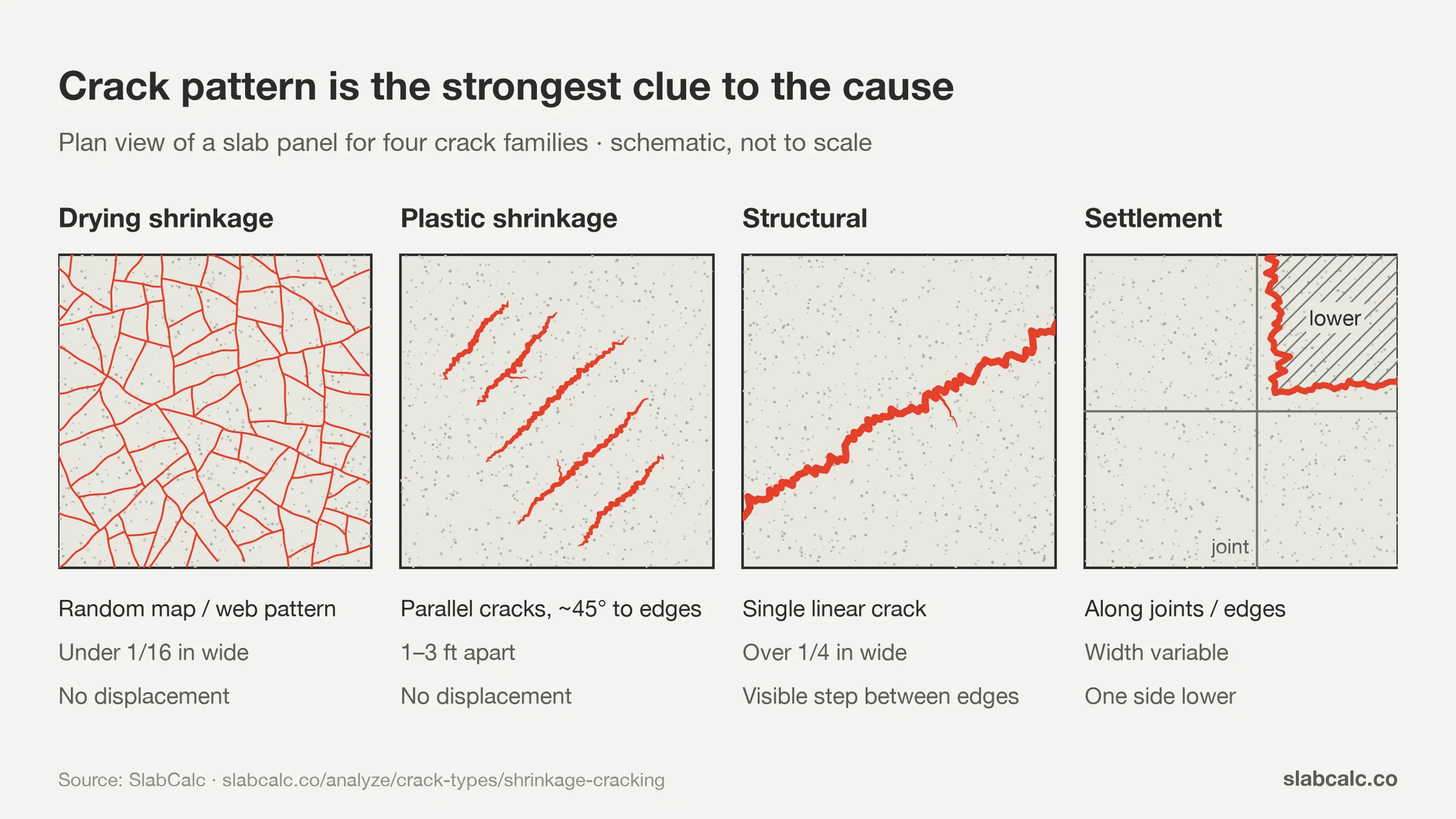
To confirm settlement, place a 4-foot straightedge or level across the crack, spanning from the higher side to the lower side. Measure the gap beneath the straightedge on the lower side — this is the displacement. Check the displacement at multiple points along the crack. If the displacement is consistent, the settlement has likely stabilized. If it varies significantly along the crack, or if the lower side rocks when you step on it, the void beneath may be larger than the visible crack suggests.
The rocking test is particularly informative. Stand on the settled (lower) section and shift your weight forward and back. If the slab moves — even slightly — there is a void beneath it. A void that allows rocking is usually large enough to require professional filling, not just surface crack repair.
Also check for secondary settlement indicators beyond the crack itself. Look for gaps between the slab and adjacent structures (a garage wall pulling away from the slab, a porch slab separating from the house foundation). Check for water pooling on the settled section — water that used to drain away now collects where the slab has dropped. Inside the building, look for sticking doors and windows, drywall cracks at door and window corners, and gaps between the wall and ceiling — these indicate foundation settlement rather than simple flatwork settlement.
Need help identifying your crack type? Upload a photo to the AI crack analyzer →
Severity Assessment
Settlement severity is determined primarily by the magnitude of vertical displacement and whether the slab serves a structural function. The following scale aligns with standard engineering practice for residential and commercial flatwork.
| Severity | Displacement | Description | Trip Hazard | Recommended Action | Est. Cost |
|---|---|---|---|---|---|
| 1 | <1/4" | Minor, barely noticeable | Low | Monitor, fix drainage | $0–$100 |
| 2 | 1/4"–1/2" | Visible step, cosmetic concern | Moderate | Grinding or lifting | $200–$800 |
| 3 | 1/2"–1" | Obvious settlement, functional issue | High | Professional lifting | $500–$2,500 |
| 4 | >1" | Major settlement, possible void beneath | Severe | Lifting + soil stabilization | $1,500–$5,000 |
| 5 | >2" or foundation | Structural risk to building | Critical | Engineering + underpinning | $5,000–$30,000+ |
ADA compliance is relevant for public sidewalks and commercial properties: any vertical displacement exceeding 1/4 inch is classified as a trip hazard under ADA Accessibility Guidelines (ADAAG Section 4.5.2). Many municipalities enforce the same standard on residential sidewalks in the public right-of-way. A homeowner who receives a trip hazard notice from the city is typically dealing with severity 2 or 3 settlement.
Foundation settlement deserves separate consideration — see the dedicated foundation cracks guide for orientation-based diagnosis of foundation-specific cracking. While a 1/2-inch settlement on a driveway is a moderate cosmetic issue, the same 1/2 inch of differential settlement on a foundation can produce visible drywall cracking and door misalignment. ACI 318 and most structural engineering references consider differential foundation settlement exceeding L/360 (where L is the span between support points) as the threshold for cosmetic damage, and L/150 as the threshold for structural concern.
Full 1–5 severity scale explained →
How to Repair Settlement Cracking
Repair starts with diagnosing and addressing the cause — no lifting method is permanent if the soil issue that created the void continues. The frontmatter steps outline the full diagnostic-to-repair process. Below is a detailed comparison of the four primary repair methods.
| Method | Best For | Hole Size | Lift Capacity | Approx. Cost | Pros | Cons |
|---|---|---|---|---|---|---|
| Mudjacking (slabjacking) | Driveways, sidewalks | 1.5–2" holes | Up to 4" lift | $4–$9/sq ft | Lower cost, proven | Heavy material (about 100 lb/ft³), may re-settle |
| Polyurethane foam lifting | All flatwork, precise leveling | 5/8" holes | Up to 8" lift | $8–$25/sq ft | Lightweight (2–4 lb/ft³), fast cure, waterproof | Higher cost, expansion less predictable |
| Slab replacement | Severely damaged slabs | N/A | N/A | $7.25–$17.50/sq ft incl. removal | Fresh start, proper base | Most expensive, 2-day project minimum |
| Self-leveling compound | Indoor floors, minor (<1/4") | N/A | Surface only | $2–$4/sq ft | DIY-friendly, smooth finish | Only for minor leveling, not structural |
Mudjacking (slabjacking) is the traditional lifting method and remains the most cost-effective option for most residential flatwork. The contractor drills 1.5-inch holes through the slab at strategic locations (typically every 3 to 4 feet), then pumps a cement-soil slurry into the void beneath the slab under hydraulic pressure. The slurry fills the void and lifts the slab to the target elevation. The holes are patched with concrete when the lift is complete. The slurry weighs approximately 35 lbs/ft cubed once cured, providing a stable fill. The primary drawback is the weight — if the underlying soil issue is ongoing, the heavy fill material can contribute to further settlement. Most mudjacking warranties run 2 to 5 years.
Polyurethane foam lifting is the newer alternative and has gained significant market share over the past decade. The contractor drills smaller holes — typically 5/8 inch — and injects a two-part polyurethane resin that expands to fill the void and lift the slab. The foam cures in minutes (versus hours for mud slurry), allowing immediate traffic. At only 2 lbs/ft cubed, the foam adds virtually no additional load to the subgrade. It is also closed-cell and waterproof, so it will not wash out or deteriorate if water reaches it. The downsides are higher cost ($5–$10/sq ft versus $3–$6 for mudjacking) and less precise control of the expansion — over-lifting can occur and is difficult to reverse.
Slab replacement is the right choice when the existing slab is too damaged to lift. If the concrete has broken into multiple pieces, exhibits widespread cracking beyond the settlement area, or if the settlement exceeds 4 inches and lifting would create stress cracks, removal and replacement is the better long-term investment. Replacement also allows the contractor to address the subgrade properly — excavating to remove problem soil, installing a compacted gravel base, and adding vapor barrier if needed. Cost runs $8–$15 per square foot for removal and replacement, with a typical 2 to 3-day project timeline.
Self-leveling compound is appropriate only for interior floors with minor settlement — under 1/4 inch. These cementitious or gypsum-based compounds are poured over the existing surface and flow to a level finish. They do not address the void or the structural deficiency beneath the slab; they only create a flat surface for flooring installation. Maximum pour depth is typically 1 to 1.5 inches per application for most products.
DIY vs. Professional
Settlement cracking offers limited DIY repair options compared to shrinkage or surface cracking. The underlying issue — a void beneath the slab — generally requires specialized equipment and materials to address.
What you can do yourself:
Grinding trip hazards is the most practical DIY option for displacements under 1/2 inch. An angle grinder fitted with a diamond cup wheel ($30–$60 rental from most equipment yards) can grind a ramp across the step, eliminating the trip hazard without lifting the slab. This does not fix the underlying settlement, but it addresses the immediate safety issue and buys time to monitor whether the settlement is ongoing. Wear eye protection, hearing protection, and a respirator rated for silica dust — grinding concrete generates fine crystalline silica particles that pose a serious inhalation hazard.
Fixing drainage is both DIY-appropriate and essential. Extending gutter downspouts to discharge at least 4 feet from the slab (10 feet is better), correcting grading to slope away from the slab, and redirecting sprinkler heads that spray against the slab are all straightforward tasks that address the most common root cause of settlement. These drainage corrections should be completed before any professional lifting, and they cost almost nothing to implement.
Filling the crack itself with polyurethane caulk or flexible sealant prevents water from entering through the crack and further eroding the subgrade. This is a surface treatment only — it does not fill the void beneath — but it slows the erosion cycle. Use a flexible sealant (not rigid epoxy) because settlement cracks may continue to move.
What requires a professional:
All slab lifting methods — mudjacking and foam lifting — require specialized pumping equipment, material knowledge, and experience reading slab response during the lift. Over-lifting a slab can crack it further or create new displacement at adjacent joints. This is not a DIY operation.
Foundation settlement requires a structural engineer's assessment before any repair work begins. The engineer determines the cause, extent, and appropriate remedy — which typically involves steel push piers or helical piers driven to stable soil or bedrock, at a cost of $1,500 to $3,000 per pier. Most residential foundations requiring underpinning need 6 to 12 piers, putting the total cost between $9,000 and $36,000. This work is performed by specialty foundation repair contractors, not general concrete contractors.
Prevention Strategies
Preventing settlement cracking is far more cost-effective than repairing it. The measures below address the root causes and should be part of every new concrete slab project.
Soil compaction: Require 95% Standard Proctor compaction (ASTM D698) on all fill material, verified by a third-party testing agency. Compaction must be done in lifts — a maximum of 6 to 8 inches of loose fill per lift. Do not allow the contractor to place and compact deep fills in a single pass; the compactive effort does not reach the bottom of the layer. For projects on fill deeper than 12 inches, consider requiring nuclear density testing at the bottom, middle, and top of the fill.
Gravel base: Install a minimum 4-inch (preferably 6-inch) base of compacted crushed gravel (3/4-inch minus or similar well-graded material) over the compacted subgrade. The gravel base provides a stable, well-drained platform that distributes the slab load and allows water to drain rather than accumulate beneath the concrete. Compact the gravel base to 95% density as well.
Drainage: This is the single most important long-term prevention measure. Extend all gutter downspouts a minimum of 4 feet from any concrete slab — 10 feet is the practical ideal. Grade the surrounding soil to slope away from all slabs at a minimum of 1/4 inch per foot (2% slope). The IRC's 6 inches in 10 feet (5% slope) is the standard for the immediate perimeter of foundations. Where subsurface water is a concern, install a French drain (perforated pipe in a gravel-filled trench, wrapped in geotextile fabric) to intercept and redirect water before it reaches beneath the slab.
Tree placement: Keep trees with aggressive root systems at least 10 feet from concrete slabs — farther for large species. Willows, silver maples, and poplars are particularly problematic. As a general rule, the minimum setback should equal the mature canopy spread radius. Roots seeking moisture will grow beneath slabs, and when they eventually die and decompose, the void they leave causes localized settlement.
Geotextile fabric: On sites with expansive clay soils (PI > 20), install a geotextile separation fabric between the clay subgrade and the gravel base. The fabric prevents clay fines from migrating into the gravel and maintains the base's drainage capacity. It does not prevent clay shrinkage, but it does reduce the interaction between the clay and the base material.
Utility trench compaction: Ensure all utility trench backfill within the slab footprint is compacted to the same 95% Proctor standard as the surrounding subgrade. If the trenches are narrow, consider using flowable fill (controlled low-strength material, CLSM) instead of compacted soil — it self-levels, fills all voids, and does not require mechanical compaction.
The Role of Water Management
Water management deserves its own discussion because it is the dominant factor in residential settlement cracking. More than 80% of settlement cases in residential flatwork trace directly to water — either surface water that erodes soil from beneath the slab, subsurface water that washes out fine particles, or moisture fluctuation in expansive clays.
Surface drainage is the first line of defense. Every inch of rain on a 1,500-square-foot roof generates approximately 935 gallons of water. If that water discharges at two downspouts directly adjacent to a driveway or patio, each downspout concentrates nearly 470 gallons per inch of rainfall at a single point next to the concrete. Over the course of a year in a region receiving 40 inches of rain, that is nearly 19,000 gallons per downspout, all cascading against the slab edge and percolating into the subgrade. The erosive potential is enormous.
The fix is straightforward: extend downspouts to discharge at least 4 feet from any slab, ideally 10 feet or more. Use rigid or flexible downspout extensions — not splash blocks, which still concentrate water too close to the structure. Better yet, connect downspouts to a buried solid pipe that carries water to a pop-up emitter or daylight outlet well away from all concrete and foundation elements.
Grading is the second critical element. The finished grade around all concrete flatwork should slope away from the slab at a minimum of 1/4 inch per foot. For the first 10 feet adjacent to a foundation, the IRC requires 6 inches of fall (approximately 5% slope). Over time, landscaping, mulch accumulation, and soil settling can reverse the original grading, directing water toward the slab rather than away. An annual visual inspection during heavy rain reveals whether the grading is still performing — watch where the water flows and where it pools.
Subsurface water is harder to manage but equally important. French drains are the standard solution for intercepting subsurface water flow before it reaches beneath a slab. A typical French drain consists of a 4-inch perforated PVC or corrugated pipe in a 12-inch-wide, 18-to-24-inch-deep trench, surrounded by 3/4-inch clean gravel and wrapped in geotextile fabric to prevent soil fines from clogging the gravel and pipe. The trench must slope at a minimum of 1% (1/8 inch per foot) toward the discharge point. French drains should be installed uphill from the slab, intercepting water before it flows beneath the concrete.
Irrigation systems are a frequently overlooked water source. Sprinkler heads that spray against or over concrete slabs saturate the soil at the slab edge with every cycle. Drip irrigation placed too close to slabs has the same effect. Leaking supply lines and valves buried near slabs can introduce steady, invisible water flow into the subgrade for months before the settlement becomes visible. If settlement is occurring near irrigated areas, pressure-test the system and inspect all heads and valves as part of the root cause investigation.
Cost Estimates
The following table summarizes typical costs for settlement crack repair methods across common residential scenarios.
| Repair Type | Cost Per Sq Ft | Typical Project Cost | Timeline | Longevity |
|---|---|---|---|---|
| Trip hazard grinding | $1–$3 | $100–$300 | 1–2 hours | Permanent (cosmetic only) |
| Mudjacking | $4–$9 | $400–$900 per 100 sq ft | 2–4 hours | 5–10 years with drainage fix |
| Polyurethane foam lifting | $8–$25 | $800–$2,500 per 100 sq ft | 1–3 hours | 10+ years (foam is waterproof) |
| Slab replacement | $7.25–$17.50 | $730–$1,750 per 100 sq ft | 2–3 days | 20–30 years with proper base |
| Self-leveling compound | $2–$4 | $200–$600 | 1 day | Dependent on substrate stability |
| Foundation underpinning | $150–$300/linear ft | $9,000–$36,000 | 3–7 days | Permanent (piers to bedrock) |
These estimates reflect 2025–2026 national averages. Costs vary by region — metro areas with high labor indices (Chicago, Los Angeles) can run 30–50% above these figures, while lower-cost markets (Charlotte, San Antonio) may run 10–20% below.
Always obtain at least 2 to 3 quotes from licensed concrete leveling contractors. Verify that the quote includes addressing the void (not just lifting the slab), and ask what warranty is provided. A contractor who lifts the slab without filling the underlying void is setting up a callback.
Estimate your concrete project cost →
Key Takeaways
- Settlement cracking is defined by vertical displacement — one side of the crack sits lower than the other. This is the single feature that distinguishes it from shrinkage, crazing, and other surface crack types.
- Water is the root cause in over 80% of residential settlement cases. Fixing drainage is the most important step in both repair and prevention.
- The rocking test (stepping on the lower slab section and feeling for movement) quickly reveals whether a void exists beneath the slab.
- Mudjacking ($4–$9/sq ft) and polyurethane foam lifting ($8–$25/sq ft) can restore settled slabs to grade in a matter of hours, with foam offering lighter weight and better longevity.
- Foundation settlement is a structural concern that requires engineering evaluation. Flatwork settlement is primarily a trip hazard and aesthetic issue.
- Prevention centers on three elements: proper soil compaction (95% Proctor density), an adequate gravel base (4–6 inches), and effective drainage (downspouts extended 4+ feet, grading at 1/4 inch per foot minimum slope).
- Always address the cause of the settlement (drainage, soil, organic decomposition) before lifting the slab. Lifting without fixing the cause guarantees recurrence.
Next Steps
- Upload a photo to the AI crack analyzer to confirm your crack type and severity
- Price lifting vs replacing your slab with metro replacement costs from the SlabCalc Concrete Cost Index
- Compare mudjacking vs polyjacking in detail, or go straight to sunken driveway or sunken sidewalk repair
- Read the subgrade preparation guide for proper base construction on new pours
- Estimate your concrete project cost with regional pricing data
- Learn why concrete cracks to understand the full spectrum of crack types and causes
- Look up the soil risk score for your city to see whether expansive soil is a likely driver of the movement you are seeing