
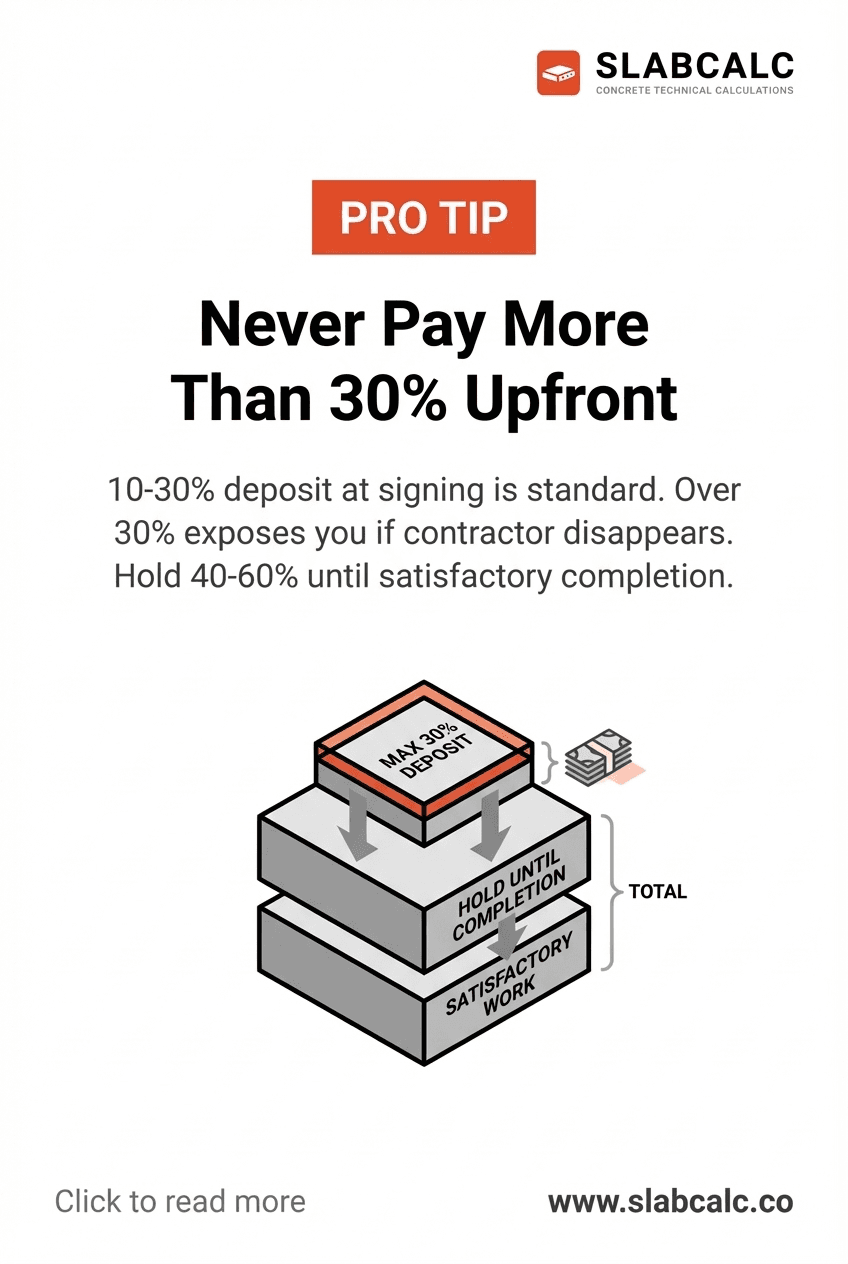
Never Pay More Than 30% Upfront
The Mistake Most Homeowners Make
A contractor gives you a quote for $8,000. They ask for 50% down—$4,000—before ordering materials and scheduling the crew. It sounds reasonable. They need cash to start, right? Three weeks later, your money is gone and so is the contractor. His phone goes straight to voicemail.
This scenario happens hundreds of times per year. Large upfront payments give contractors zero incentive to finish your job. If they're juggling multiple projects and cash flow is tight, your deposit becomes working capital for someone else's driveway.
The Professional Payment Structure
Industry standards exist for a reason. The safe payment schedule is:
- 10–30% deposit at contract signing (just enough to secure materials and schedule)
- 30–40% at mid-project when base prep or concrete pour begins
- 40–60% held until final inspection and approval
This structure keeps leverage on your side. The contractor completes work to earn the remaining balance. If they disappear mid-project, you've only lost a small deposit—recoverable through small claims court—not half the job cost.
Why This Works
Concrete jobs are completion-dependent. A poured slab with no finishing is worthless. Holding 40–60% of total cost until satisfactory completion means your contractor must show up and deliver quality work. They can't vanish; they lose significant money.
Compare this to paying 50% upfront: you've already transferred half the risk to yourself. Contractors know they can't recover unpaid labor easily, so they might cut corners, use cheaper materials, or abandon the job if cash dries up elsewhere.
The 30% rule also covers contractor cash flow legitimately. They can order rebar, ready-mix concrete, and forms without your entire payment, but not enough to fund five simultaneous projects or cover personal expenses.
How to Implement This
1. Write it into the contract. State the exact payment schedule: "10% due upon signing. 30% due before material delivery. 60% due within 5 days of final inspection approval." Make it specific to milestones, not calendar dates.
2. Require proof before each payment. Before releasing the mid-project payment, inspect materials on-site or request delivery receipts. Before final payment, walk the job yourself or hire a third-party inspector (costs $150–$300).
3. Use a retainage agreement. In some states, you can legally hold back 10% for 30 days after project completion as a quality guarantee. Your contract can specify this.
4. Get it in writing from your contractor. If they balk at the 30% deposit rule, that's a red flag. Licensed professionals expect this standard. Anyone demanding 40%+ upfront is either desperate or unreliable.
5. Never pay cash. Use checks or bank transfers that create a paper trail. If a dispute arises, you have proof of payment amounts and dates.
The 30% rule isn't arbitrary—it's the balance point that protects both parties. Respect it, and you dramatically reduce the risk of losing money to a vanishing contractor.