
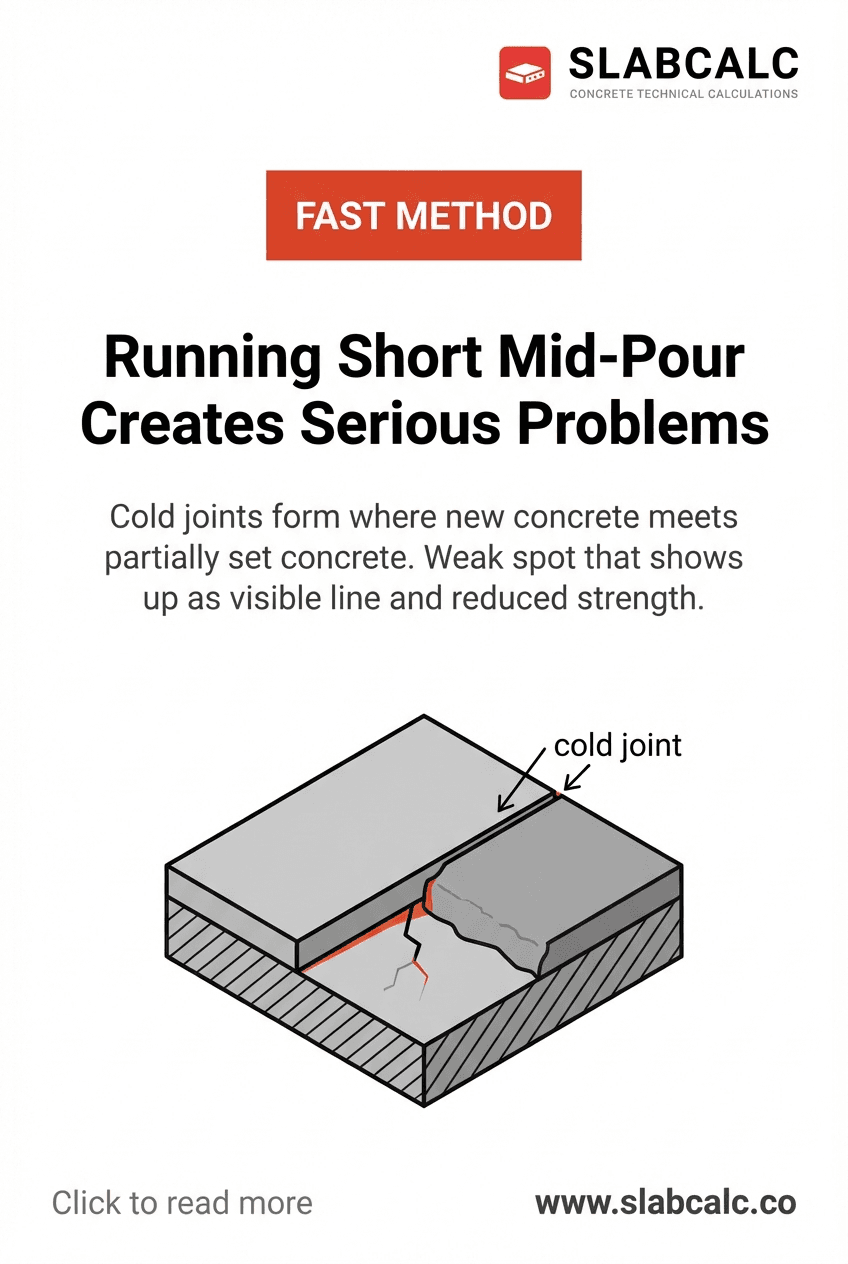
Running Short Mid-Pour Creates Serious Problems
The Slow Way vs. The Fast Way
Slow way: Manually measure your slab in feet and inches, hunt for a conversion chart, do the math by hand, hope you didn't miss anything. Time spent: 25–40 minutes. Accuracy: 60–70%. Stress level: High.
Fast way: Input your measurements into a concrete calculator, get your exact cubic yardage in 90 seconds, order with confidence. Time spent: 2 minutes. Accuracy: 99%. Stress level: Zero.
The difference? One method catches your mistakes before the truck arrives. The other catches them during the pour—when a cold joint becomes inevitable.
Why Cold Joints Are a Real Problem
A cold joint forms when new concrete contacts partially set concrete. It's a visible horizontal line where two pours meet, and it's structurally weak.
Here's what happens: Your 10 × 12 foot patio needs 1.62 cubic yards. You order 1.5 yards thinking you're being thrifty. Halfway through the pour, the concrete runs out. Now you're waiting 24–48 hours for a partial truck delivery—a minimum charge of $75–$150. While you wait, the first concrete hardens. When the second batch arrives, the new concrete doesn't bond properly to the old surface.
The result? A visible seam that's 20–30% weaker than solid concrete. It'll crack, spall, or fail prematurely under freeze-thaw cycles or heavy loads.
The Correct Calculation Method
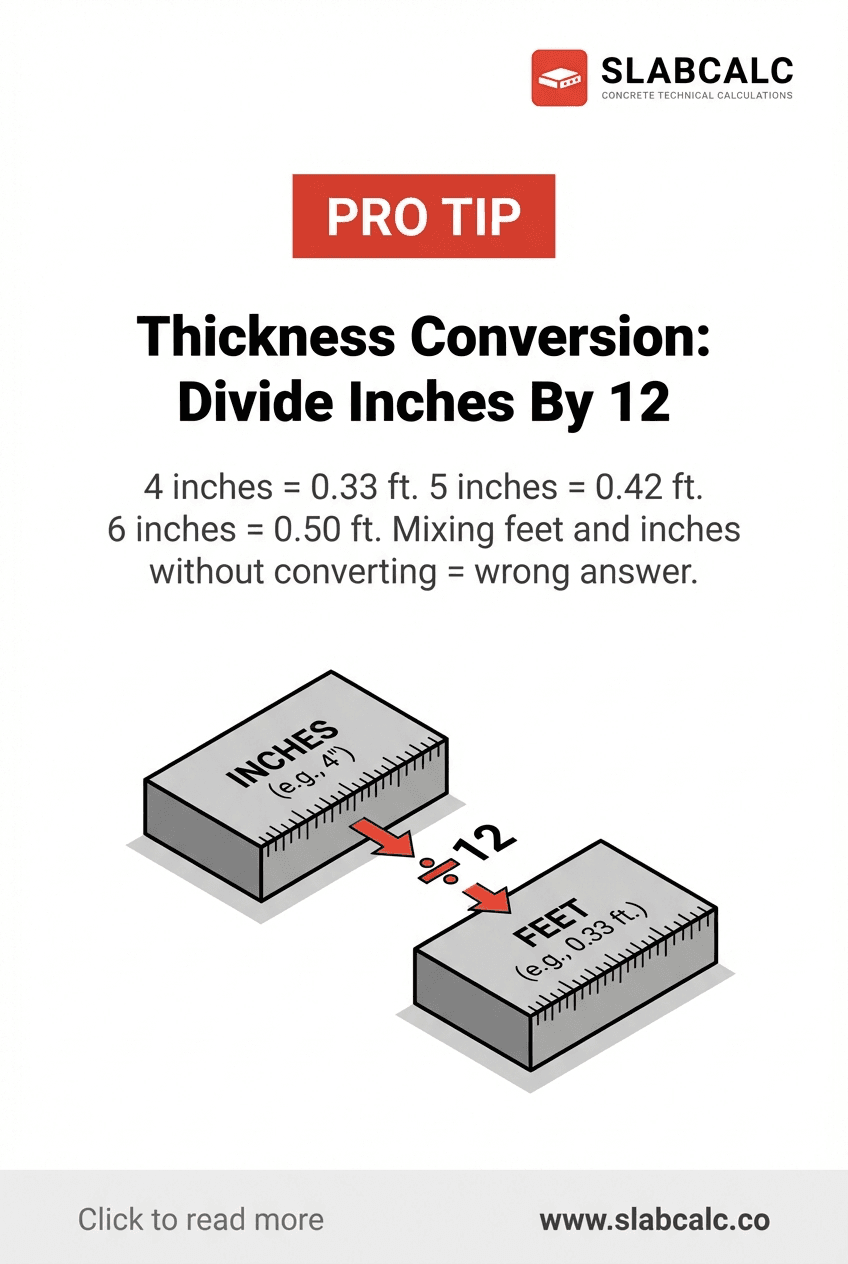
Step 1: Measure in feet only Convert everything to feet before multiplying. A 4-inch thickness = 0.33 feet (4 ÷ 12). A 3-inch curb = 0.25 feet. Write these conversions down.
Step 2: Apply the formula Length × Width × Thickness ÷ 27 = Cubic Yards
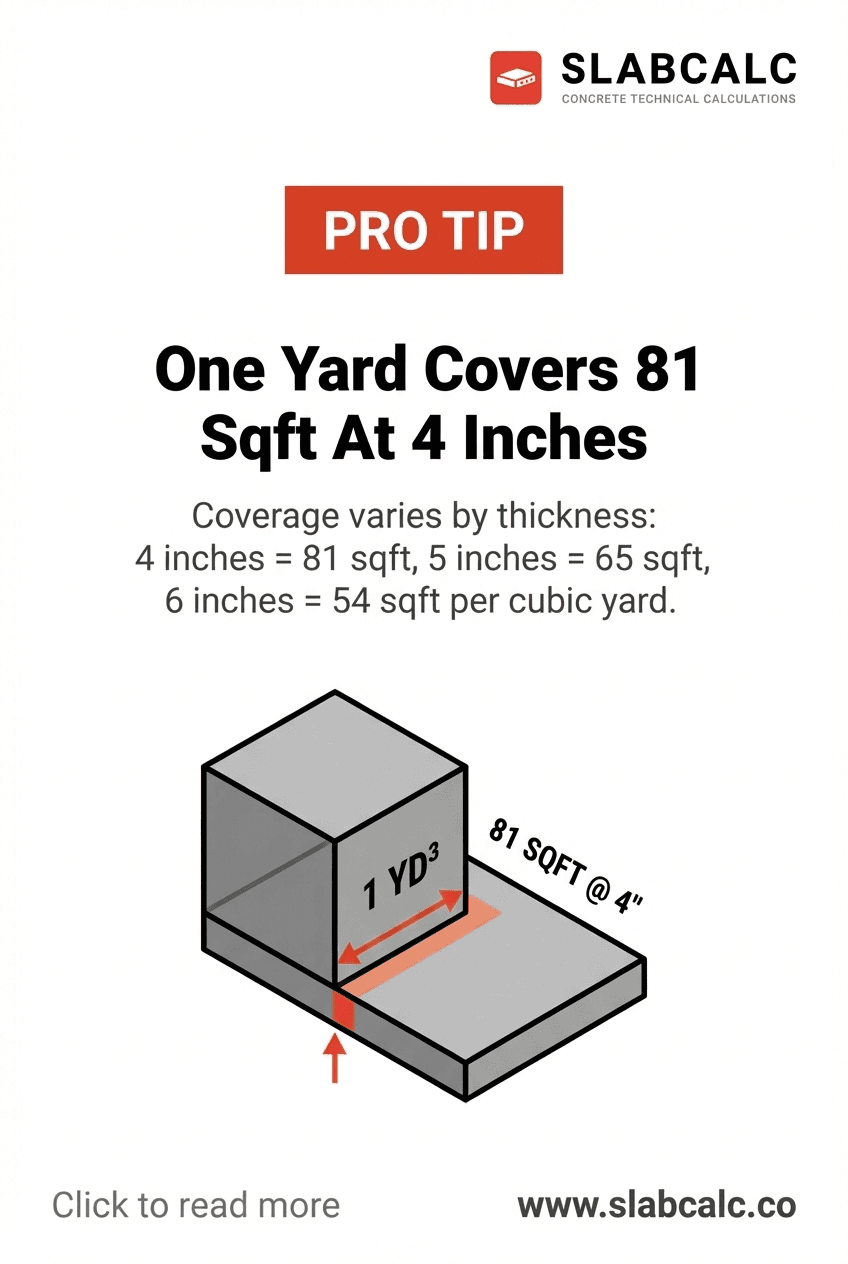
For a 12 × 10 foot slab at 4 inches: 12 × 10 × 0.33 ÷ 27 = 1.47 cubic yards
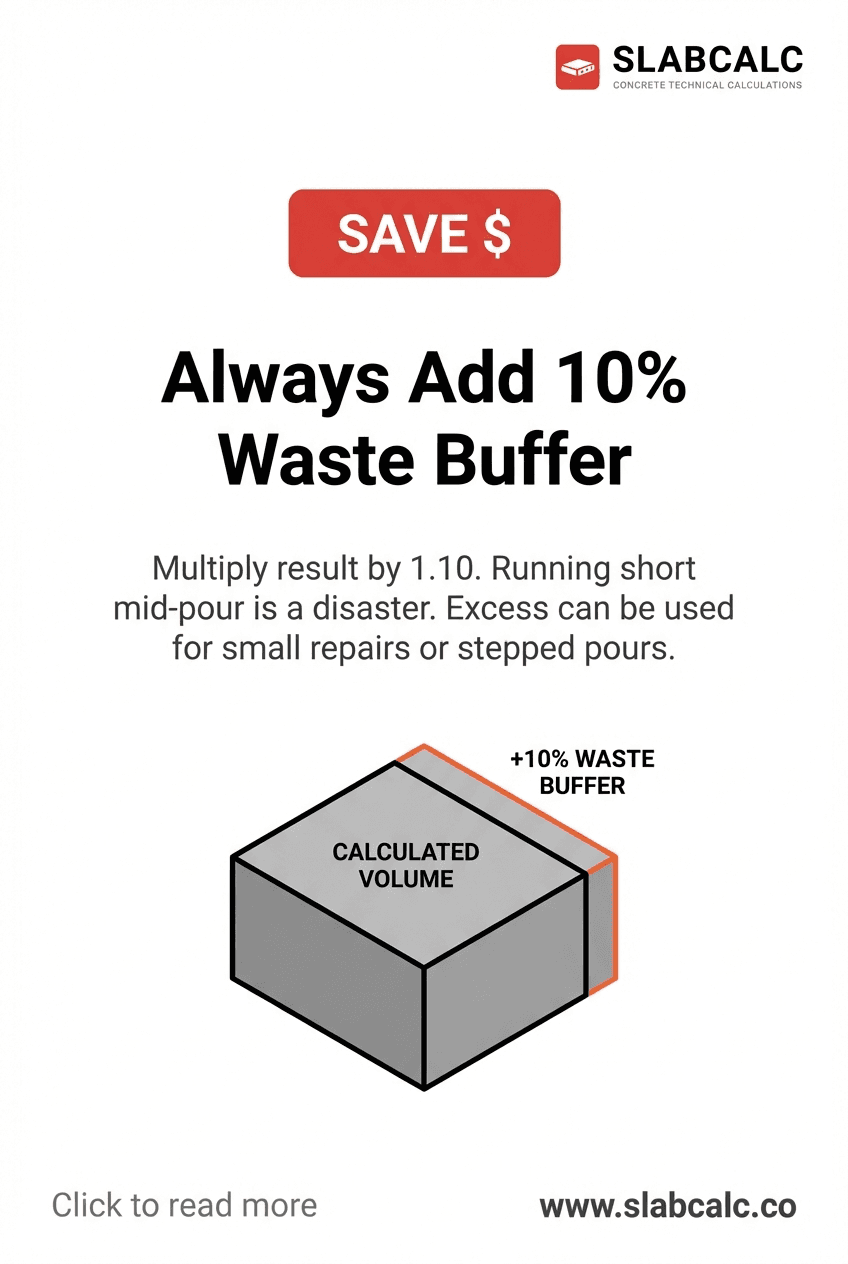
Step 3: Add 10% buffer 1.47 × 1.10 = 1.62 cubic yards. Order 1.75 or 2 yards.
Tools You Actually Need
- Steel tape measure (25-foot minimum, not a cloth one that sags)
- Pencil and paper (write down every measurement immediately)
- Concrete calculator (eliminates unit-conversion errors in 90 seconds)
- Level (to check if your ground dips below expected depth)
The Timing Benchmark
A professional crew pours a 12 × 10 foot slab in 90–120 minutes start to finish. Once concrete trucks arrive, you cannot pause. You either have enough material, or you don't.
Getting your math right takes 2 minutes with a calculator. Fixing a cold-jointed slab takes weeks of work and costs $800–$2,000 in concrete removal and replacement.
The decision is simple: spend 2 minutes calculating correctly now, or spend 2 months dealing with structural damage later.