
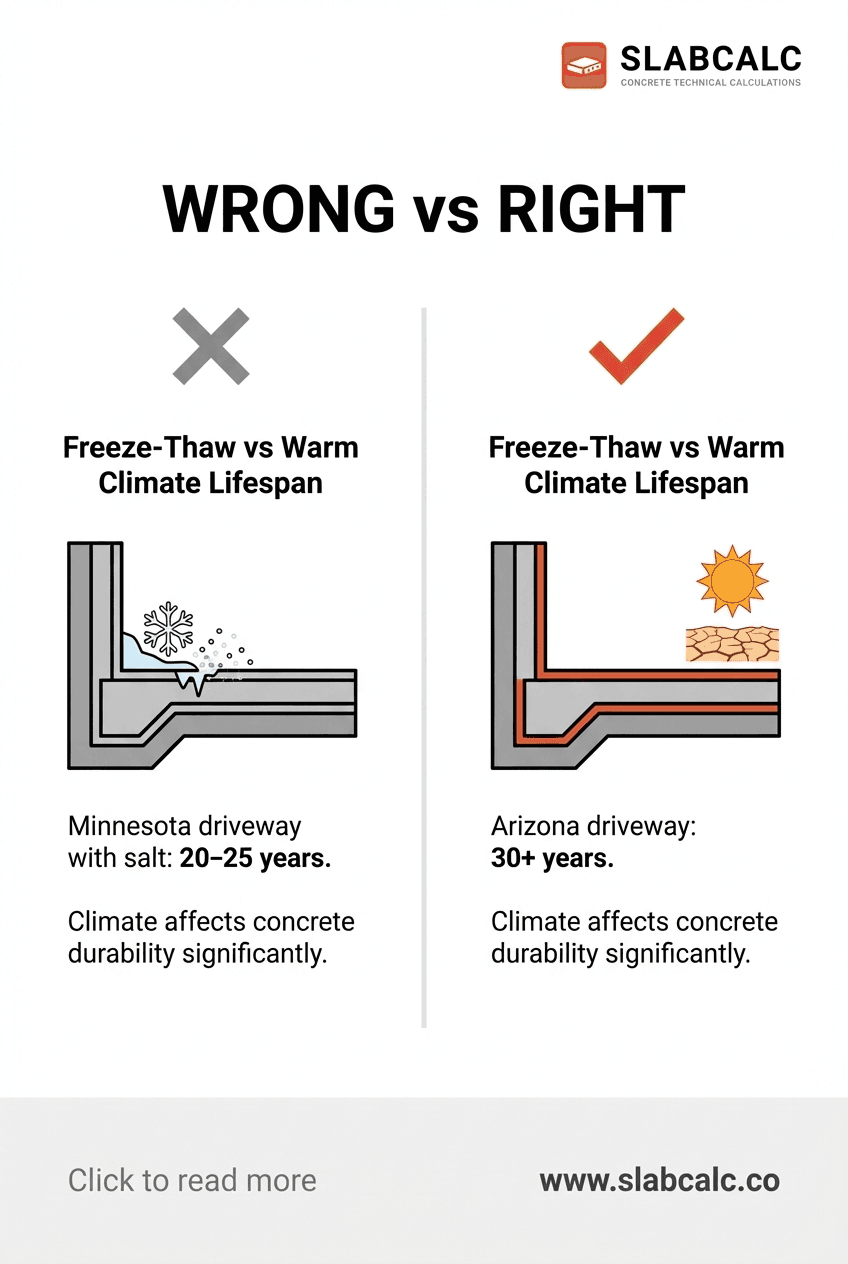
Freeze-Thaw vs Warm Climate Lifespan
Your concrete won't last the same length of time everywhere. A driveway in Minnesota exposed to winter salt and freeze-thaw cycles typically survives 20–25 years. The same slab design in Arizona can reach 30+ years. Climate is not just a minor factor—it's often the deciding factor in how long your concrete investment lasts.
The Freeze-Thaw Decision Tree
If you live where temperatures drop below freezing regularly and road salt is applied: Then expect 20–25 years for a driveway, 15–20 years for steps. Plan for seal-coat reapplication every 2–3 years ($0.10–0.25/sq ft per coat) to extend life.
If you live in a mild climate with minimal freeze-thaw and no de-icing salt: Then expect 30+ years for driveways, 25–40 years for patios. Maintenance is lighter; seal every 3–5 years.
If you're in a transition zone (occasional freezing, minimal salt use): Then expect 25–30 years with moderate maintenance. Your concrete sits between the two extremes—treat it accordingly.
Why Freeze-Thaw Destroys Concrete
Water is concrete's enemy in cold climates. Here's the mechanism: moisture seeps into tiny pores in the slab. When temperature drops below 32°F, that water freezes and expands by 9%. This expansion creates internal pressure that cracks the concrete from within. Over dozens of winter cycles, these micro-fractures grow into visible spalling and structural failure.
Road salt accelerates this damage. Salt lowers the freezing point of water, allowing brine to penetrate deeper into the slab before freezing. It also triggers a chemical reaction (ettringite formation) that deteriorates the concrete matrix itself. A Minnesota driveway absorbing salt-laden runoff fails 5–10 years faster than one without salt exposure.
Factors Most People Overlook
Drainage beneath the slab. Even in dry climates, poor drainage under concrete traps moisture. In cold regions, this trapped water freezes and causes upheaval. A 4-inch gravel base with proper slope (1/8 inch drop per foot) is non-negotiable in freeze-thaw zones.
Air entrainment. Concrete designed for cold climates must contain tiny air bubbles (4–8% by volume) that allow water to expand without cracking the paste. Standard mixes often lack this. Specify air-entrained concrete in Minnesota; skip it in Arizona.
Sealing timing. Seal within 28 days of pour in cold climates; wait 2–3 months in warm climates. Early sealing in freeze-thaw zones prevents salt brine penetration during year one.
Chloride threshold. Concrete can tolerate about 1 pound of chloride per 100 square feet before rebar corrosion accelerates failure. In high-salt regions, you'll hit this threshold around year 15–18.
Your Action Plan
Before pouring, determine your climate zone and expected salt exposure. In freeze-thaw regions, budget $1,500–3,000 every 5 years for seal-coat maintenance on a 500-sq-ft driveway. In warm climates, budget $500–1,000 every 5 years. Specify air-entrained concrete and proper base preparation upfront—this single decision can add 5+ years to lifespan. If you're building in Minnesota, accept 20–25 years as realistic; in Arizona, plan for 30+ years with normal care.