
Concrete Research & Data
Original datasets SlabCalc builds and maintains from primary government and scientific sources — what concrete costs, how hard the climate is on it, and what the ground underneath does to it. Free to cite, reference, and reuse.
The SlabCalc Concrete Cost Index
Professional installed concrete costs across 26 US metros, built from public bid-tabulation records rather than contractor-submitted estimates.
New York is the most expensive bid-data metro at $13.68/sq ft on the low end, 4.1× the cheapest.
Last updated: October 20, 2026
The SlabCalc Freeze-Thaw Index
Mean annual air freeze-thaw cycle counts for 180 US cities, derived from NOAA GHCN-Daily station records, with recommended concrete air content by city.
Carson City, NV leads at 174.1 cycles a year; 132 of 180 cities need air-entrained concrete.
Last updated: October 12, 2026
The SlabCalc Soil Risk Index
Area-weighted expansive soil risk scores for 180 US cities, built from USDA NRCS SSURGO soil survey data, with slab design guidance by risk band.
New Orleans, LA scores highest at 100/100; 18 of 180 cities fall in the high or very high bands.
Last updated: October 15, 2026
What the Indices Show Together
Cheapest concrete, uneven ground
The lowest installed costs in the Concrete Cost Index (from $3.33/sq ft on the low end) belong to Atlanta, Detroit, St. Louis, Charlotte, San Antonio. Their expansive-soil risk in the Soil Risk Index ranges widely:
- San Antonio, TX: soil risk 77/100
- St. Louis, MO: soil risk 38/100
- Atlanta, GA: soil risk 35/100
- Charlotte, NC: soil risk 26/100
- Detroit, MI: soil risk 10/100
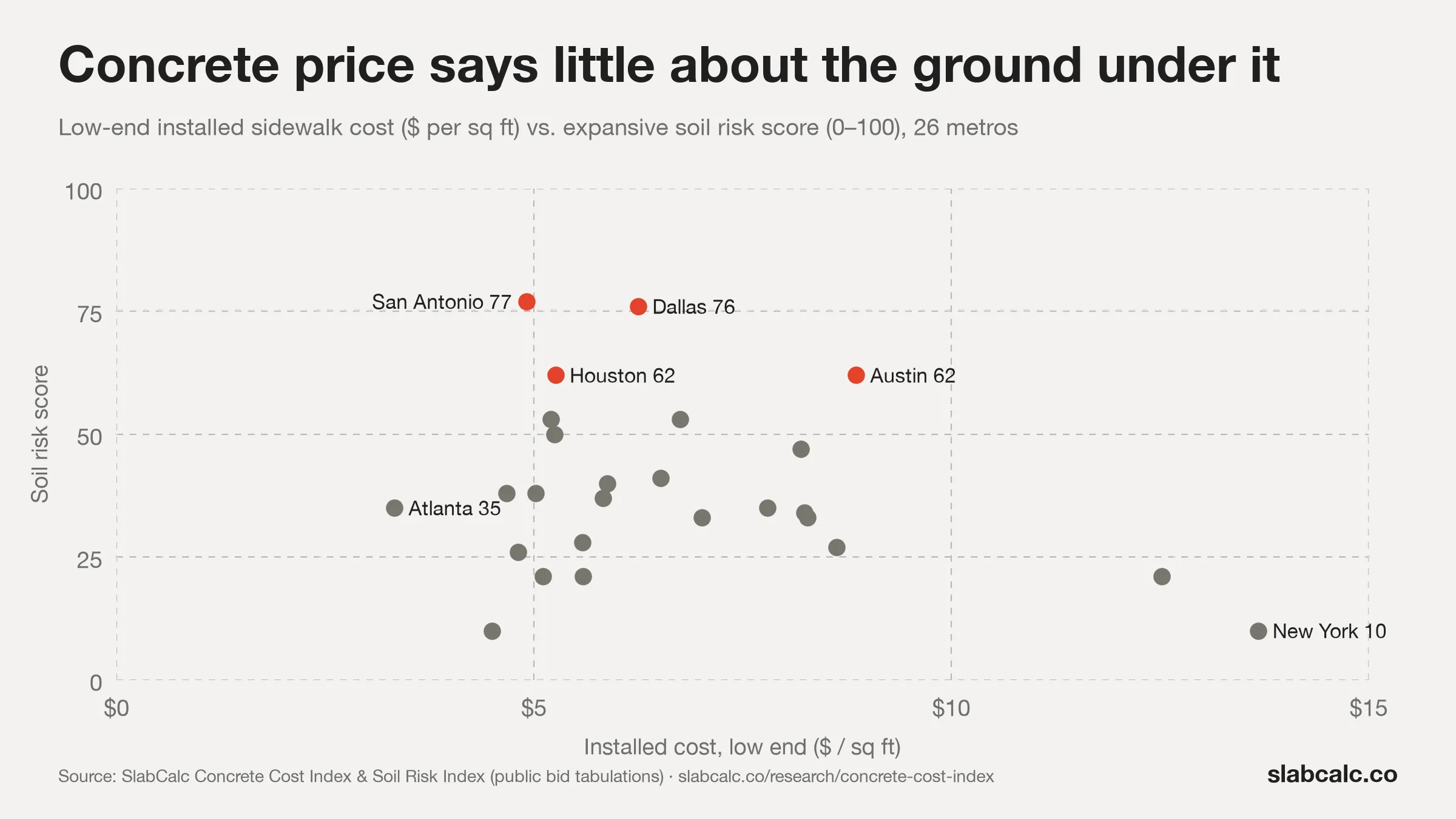
New York, the most expensive metro at $13.68/sq ft, scores 10/100 on soil risk. Price per square foot says little about what a slab that lasts will cost once soil preparation and slab design are included.
Double exposure: freeze-thaw and expansive soil
These cities fall in the high bands of both the Freeze-Thaw Index and the Soil Risk Index, so exterior slabs face both surface scaling and ground movement:
- Durham, NC: 51.3 freeze-thaw cycles/yr, soil risk 84/100
- Overland Park, KS: 77.5 freeze-thaw cycles/yr, soil risk 71/100
- Topeka, KS: 92.5 freeze-thaw cycles/yr, soil risk 69/100
- Lincoln, NE: 110.1 freeze-thaw cycles/yr, soil risk 67/100
Citing & Coverage
Each index page carries a ready-to-use citation and DOI. For articles that draw on this research, see Press & Mentions. Questions about the data: contact@slabcalc.co.