

Dry Pour Concrete: Does the No-Mix Technique Actually Work?
Dry pour concrete — pouring dry mix directly into a hole and adding water on top — sounds almost too easy. No mixing, no wheelbarrow, just dump and done. The technique is legitimate and endorsed by Quikrete and Sakrete for specific applications. But it only works in one situation, and using it outside that situation produces weak, uneven results.
The technique is legitimate and endorsed by Quikrete and Sakrete for specific applications. But it only works in one situation, and using it outside that situation produces weak, uneven results.
What Is Dry Pour Concrete?
The dry pour method:
- Dig the hole to the required depth and diameter
- Set the post in the hole
- Pour dry (unmixed) fast-setting concrete mix directly around the post
- Add water on top — slowly, until the mix is saturated
- Leave it alone; the concrete sets within 20–40 minutes
No mixing container, no hoe, no wheelbarrow. The post stands on its own in about 4 hours.
This method works because of a key fact: a post hole provides moist soil on all sides. That soil moisture, combined with the water you pour on top, is enough to initiate and sustain the hydration reaction throughout the concrete column. The cylindrical shape with enclosed walls ensures the water-to-dry-mix ratio is relatively consistent throughout.
When Dry Pour Works — Post Holes
Post holes are the only appropriate use for dry pour concrete. Specifically:
- Fence posts (wood and metal)
- Mailbox posts
- Sign posts
- Deck posts (follow local code requirements)
- Basketball pole anchors
- Lamp posts and flagpoles
For a step-by-step guide to setting fence posts this way, see concrete fence post guide and concrete mailbox post.
When Dry Pour Does NOT Work
Never use dry pour for:
- Slabs (patios, driveways, sidewalks)
- Footings or foundations
- Any horizontal pour
- Retaining walls
- Steps
In a horizontal application, water pools and channels rather than penetrating evenly. The result is sections of over-wet concrete, sections of under-wet concrete, and completely dry pockets — all in the same pour. Structural failure is likely.
How to Dry Pour a Post Hole Correctly
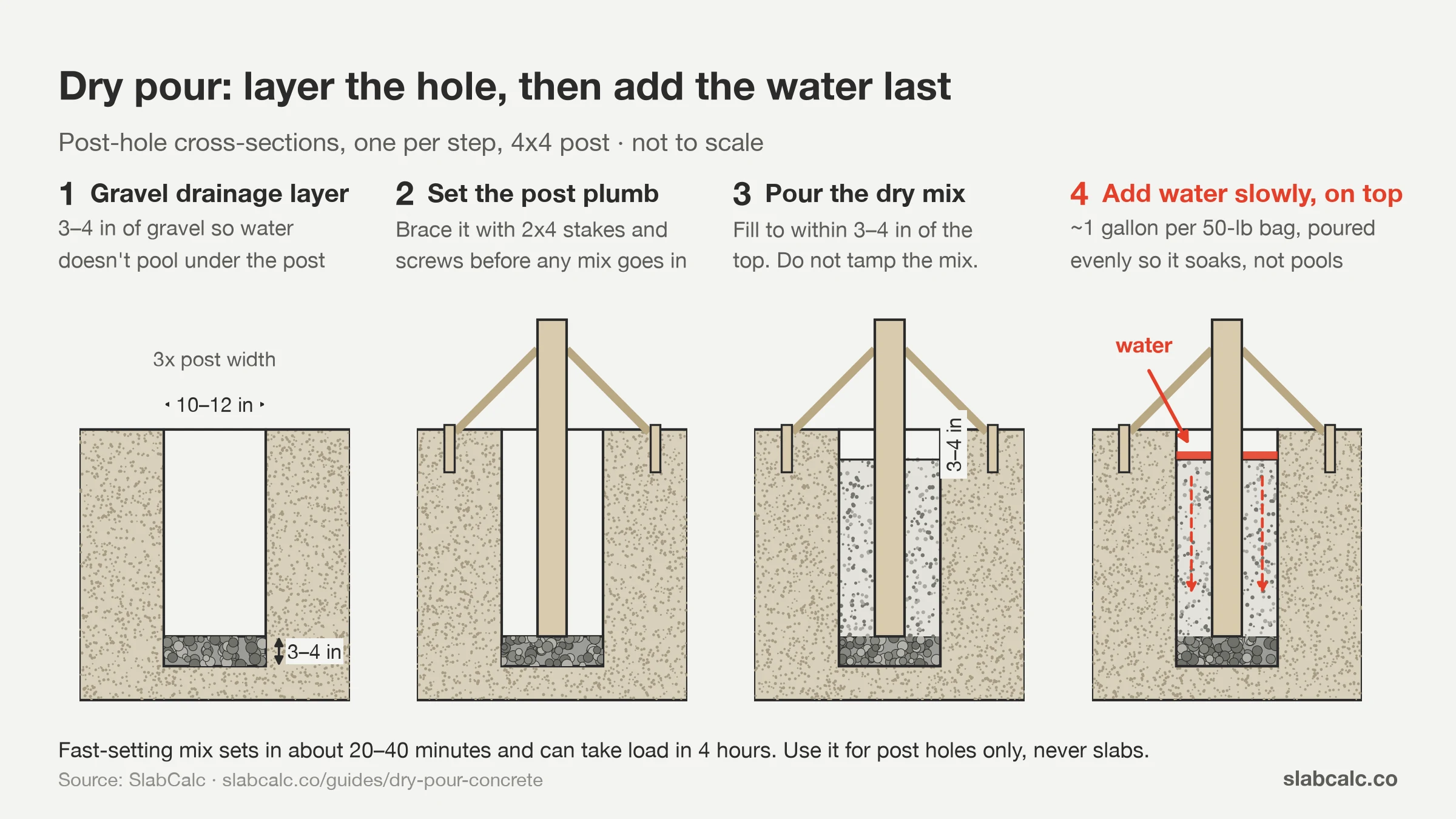
Step 1: Dig the Right Size Hole
Hole depth should be 1/3 to 1/2 of the above-ground post height (at least 12 inches), with the bottom below the frost line in your area. Hole diameter should be about 3× the post width (e.g., a 4×4 post, 3.5 inches actual → a 10–12 inch hole).
Use this calculator to figure out how many bags you need:
Includes 10% waste factor
Step 2: Add a Gravel Drainage Layer
Put 3–4 inches of gravel at the bottom of the hole before setting the post. This prevents water from pooling under the post base and causing premature rot.
Step 3: Set the Post and Check Plumb
Place the post and brace it plumb with 2×4 stakes and screws. It needs to be plumb before the concrete is poured — you won't be able to adjust it once the mix goes in.
Step 4: Pour the Dry Mix
Pour the dry concrete mix directly into the hole around the post. Fill to within 3–4 inches of the top (to allow for adding water). Do not tamp or compact the dry mix.
Step 5: Add Water Slowly
Pour water slowly and evenly over the surface of the dry mix — approximately 1 gallon per 50-lb bag. The water should absorb into the mix, not pool on top. If it pools, wait 30 seconds and pour more slowly.
Don't pour water all at once. The goal is consistent saturation, not flooding.
Step 6: Leave It Alone
Do not disturb the post for at least 4 hours. Standard working: brace it and come back the next morning before loading.
The Right Product for Dry Pour
Use only products specifically rated for dry pour:
- Quikrete Fast-Setting Concrete Mix — explicitly lists dry pour as an approved method
- Sakrete Fast-Setting Concrete Mix — same
Do NOT use standard all-purpose concrete mix for dry pour. It doesn't set fast enough, and the aggregate size creates more gaps in the dry mix column.
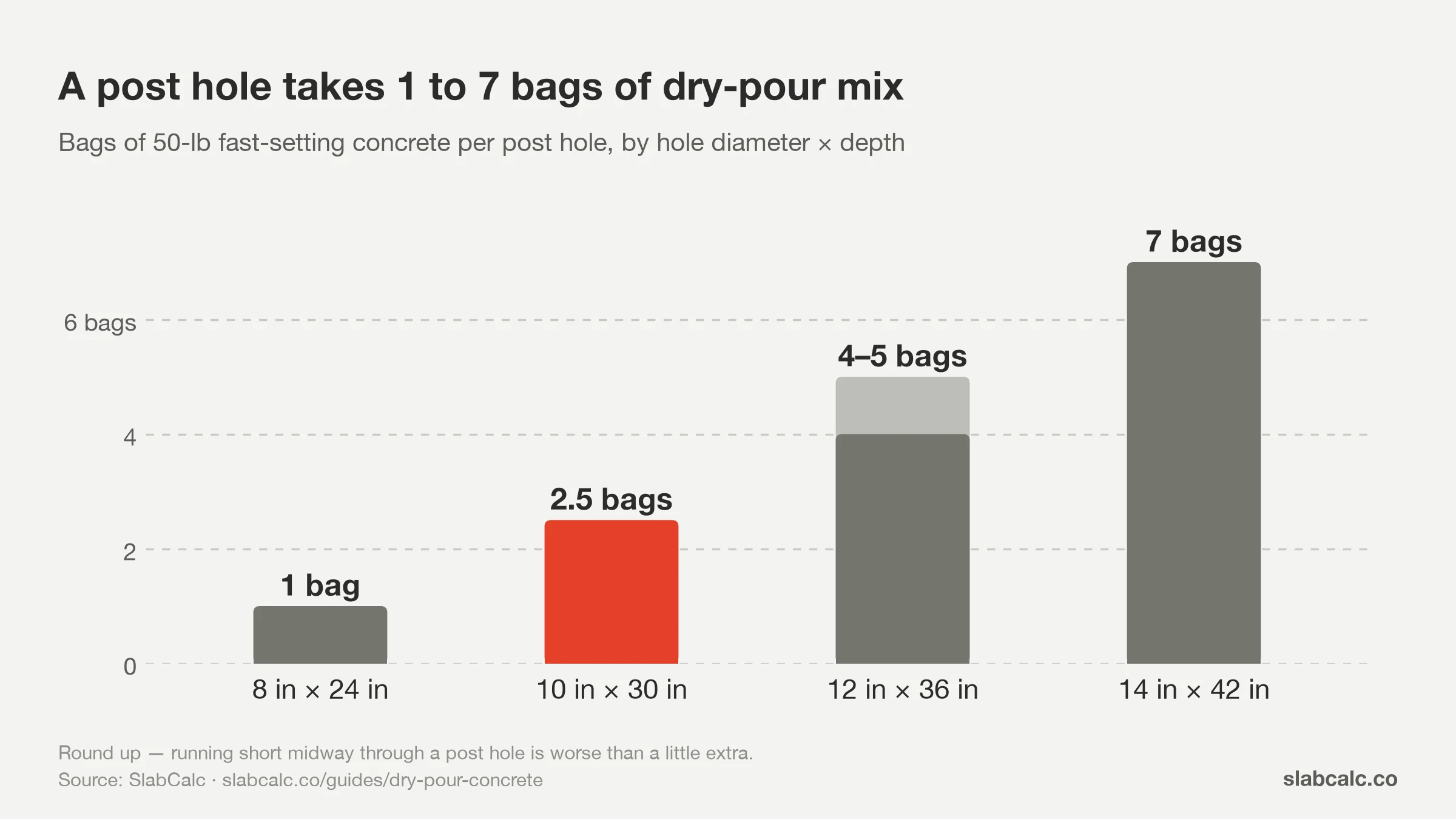
How Many Bags Per Post Hole?
| Hole Diameter | Hole Depth | Bags Needed (50-lb) |
|---|---|---|
| 8 inches | 24 inches | 1 bag |
| 10 inches | 30 inches | 2.5 bags |
| 12 inches | 36 inches | 4–5 bags |
| 14 inches | 42 inches | 7 bags |
Round up — running short on a post hole midway through is worse than having a little extra.
Dry Pour vs. Pre-Mixed for Posts
Choose dry pour when:
- Setting 1–5 posts; speed is the priority
- You don't want to carry/clean a wheelbarrow
- Using fast-setting product for the 4-hour turnaround
Choose pre-mixed when:
- Setting many posts (renting a mixer makes sense)
- You're concerned about concrete quality and uniformity
- Local code requires a specific PSI spec
Both methods produce solid results in post holes when done correctly. For most homeowners, dry pour with fast-setting product is the fastest and lowest-cleanup option.
Related Guides
- Concrete Fence Post Guide — Full guide including hole sizing and post spacing
- Concrete Mailbox Post — Applying the dry pour method for a mailbox installation
- How to Mix Concrete — For projects that need pre-mixed concrete instead