

DIY Concrete Fire Pit Pad: How to Build a Safe, Level Base
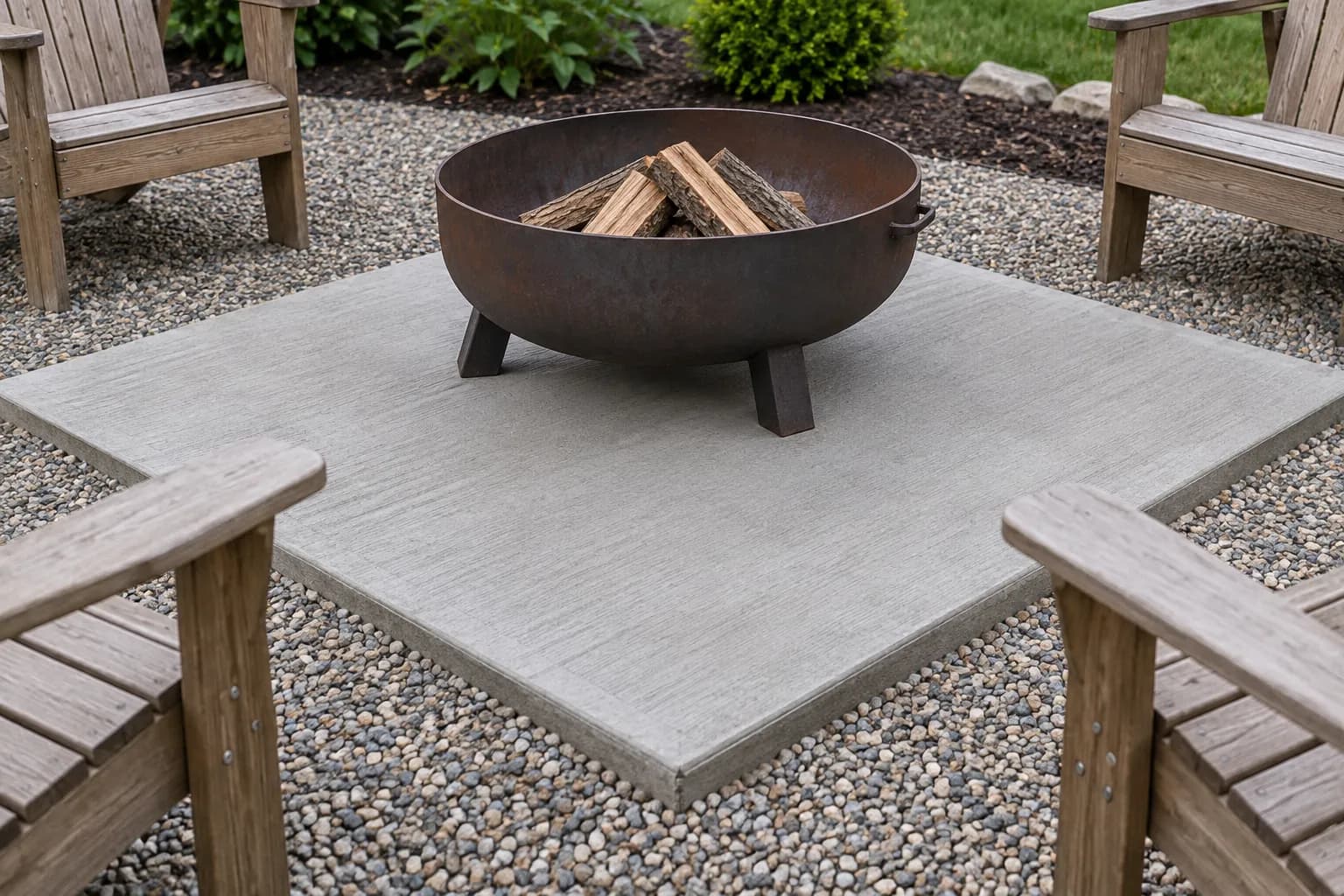
A concrete pad under a fire pit is safer than bare ground or pavers, more durable than patio blocks, and straightforward to pour. The key differences from a standard slab are size (larger perimeter clearance), heat considerations, and often a circular shape.
This guide covers everything specific to fire pit pads. For the core slab-pouring process, see our small concrete slab guide — the steps are nearly identical.
What You Need
Materials
| Item | Notes |
|---|---|
| 80-lb bagged concrete (3,000 PSI) | See bag count below |
| Form lumber (1×4 or 1×6) | For circular forms: use bender board or thin plywood strips |
| Bender board (3–4 lengths) | Flexible form for circular shape |
| Wood stakes (18") | Every 12" around circular form |
| Gravel (3/4" crushed) | 4-inch base |
| Wire mesh or #3 rebar | Reinforcement |
| 6-mil poly sheeting | Curing |
Tools
- Tape measure and string
- Screwdriver or impact driver
- Plate compactor (rent)
- Shovel and wheelbarrow
- Screed board
- Bull float
- Edging tool
Determining Pad Size
The minimum rule: fire pit diameter + 12 inches on each side = minimum pad diameter.
| Fire Pit Diameter | Minimum Pad Size | Comfortable Pad Size |
|---|---|---|
| 24" | 48" (4 ft) | 60" (5 ft) |
| 36" | 60" (5 ft) | 72" (6 ft) |
| 48" | 72" (6 ft) | 84" (7 ft) |
A 6-foot round pad is the sweet spot for most backyard fire pits — large enough to be safe, small enough to be manageable as a DIY pour.
How Much Concrete?
For a 6-foot diameter circular pad at 4-inch thickness:
- Area = π × (3 ft)² = 28.3 square feet
- Volume = 28.3 × (4/12) = 9.4 cubic feet ≈ 0.35 cubic yards
- Bags needed: ~16 bags of 80-lb mix (add 10% = 18 bags)
Includes 10% waste factor
Open the full Concrete Slab Calculator →
Note: The calculator uses rectangular dimensions. For a circle, use the diameter for both length and width, then multiply the result by 0.785 to account for the circular shape.
Building a Circular Form
Circular forms require flexible material — standard lumber won't bend. Options:
Bender board: Thin strips of hardboard, plastic, or fiber available at landscaping suppliers. Soak wood bender board in water for 30 minutes before bending. Stake every 12 inches around the perimeter.
1/4-inch plywood strips: Rip 4-inch-wide strips from a sheet of 1/4-inch plywood. Bend around stakes and screw ends to stakes to hold the curve.
Kerf-cut 2×4: Cut shallow kerfs (slots) in the top edge of a 2×4 every 2–3 inches to make it flexible enough to bend. Labor-intensive but uses common materials.
For more on form construction and staking, see our how to build concrete forms guide.
Setting the Circle
Drive a stake at the center of the pad location. Attach a string equal to the pad radius. Walk the string around the stake, marking the perimeter with spray paint or chalk dust every 6 inches. Drive form stakes just outside the marked circle and bend the form material around them.
Step-by-Step
Step 1: Excavate and Compact
Excavate 8 inches deep (4" gravel + 4" concrete) inside the marked circle. Compact the subgrade thoroughly with a plate compactor.
Add 4 inches of crushed gravel in two 2-inch lifts, compacting each. The subgrade and base are the most important factors in preventing cracking — a solid base prevents settlement cracks far more than reinforcement does.
See our subgrade preparation guide for compaction standards.
Step 2: Install Reinforcement
For a 6-foot pad, wire mesh (6×6 W1.4) is adequate. Place on 2-inch chairs to position at mid-slab depth. For pads exceeding 8 feet in diameter, use #3 rebar on 18-inch centers.
Step 3: Pour and Screed
Pour concrete to slightly above form height. Screed with a straight board resting on the form edges. For a circular form, a shorter screed board (24–30 inches) is easier to work with than a full 8-foot board.
Work in sections, filling and screeding a quarter at a time.
Step 4: Finish
Wait for bleed water to disappear (surface changes from shiny to matte). Float the surface with a hand float, edge the perimeter, and apply a broom finish for slip resistance and heat grip.
For the best time to pour considering temperature, see our best time to pour concrete guide — fire pit pads installed in high summer heat need extra curing attention.
Step 5: Cure
Cover immediately with plastic. Cure for 7 days minimum. The concrete reaches full strength at 28 days — don't use the fire pit before then.
Key Specs
| Spec | Recommendation |
|---|---|
| Pad size | Fire pit diameter + 12" per side |
| Thickness | 4 inches minimum |
| Base | 4" compacted gravel |
| Concrete type | Standard 3,000 PSI |
| Reinforcement | Wire mesh (W1.4) or #3 rebar |
| Finish | Broom finish (slip resistance) |
| Cure before use | 28 days |
Common Mistakes
Undersizing the pad. A pad that extends only 4–6 inches past the fire pit looks cramped and leaves the surrounding surface unprotected from heat and embers. Go bigger — 12 inches of clearance minimum.
Skipping base compaction. Fire pit areas often sit on soft lawn soil. Without compaction, the slab settles unevenly and tips the fire pit. Always compact and add gravel base.
Using refractory mix when you don't need it. Heat-resistant concrete is needed for applications like fire boxes and chimneys — not for a pad sitting 12 inches away from the fire. Standard 3,000 PSI concrete is fine.
Related Guides
- Small Concrete Slab Guide — Core pouring process for slabs under 100 sq ft
- How to Build Concrete Forms — Form construction for any shape
- Best Time to Pour Concrete — Temperature, weather, and timing considerations