

Concrete Foundation Cost in Portland, OR
Homeowner estimates · Updated 2026-11-03
Homeowners in Portland, OR typically pay $6,328–$26,940 total for a slab foundation (800–1,200 sq ft) ($7.91–$22.45 per sq ft installed). Estimated from 28 Oregon bid contracts, adjusted for residential market rates.
Typical Homeowner Cost
Low
$7.91
per sq ft
Mid
$15
per sq ft
High
$22.45
per sq ft
How this estimate is built ▾
Step 1 — DOT bid data
28 Oregon DOT bid tabulations, Region 1 bid contracts (2023–26) → p25/p75 installed $/sq ft at prevailing wage rates.
Step 2 — Residential adjustment
BLS open-shop wage $36.05/hr ÷ Oregon DOT bid tabulations, Region 1 prevailing wage $48/hr × 50% labor share → homeowner estimate is 69% of contractor rate.
Step 3 — Local indices
Labor index: 31% above national (BLS OES, cement masons). Material index: national average (USGS aggregate prices).
Step 4 — Project type
Foundation complexity multiplier: 1.10×–1.45× applied to base flatwork rate.
Contractor / Professional Rate(government & commercial projects)▾
Low
$11.44
per sq ft
Mid
$22
per sq ft
High
$32.45
per sq ft
Sourced from 28 Oregon DOT bid tabulations, Region 1 bid contracts (2023–26). These prices reflect government and commercial work where contractors are legally required to pay prevailing wages — typically 20–40% above open-shop residential rates.
DOT Verified — Oregon DOT bid tabulations, Region 1 (2023–26)↗In Portland's rainy climate, foundation drainage and vapor barriers are critical cost items — the high annual rainfall creates persistent ground moisture that affects slab performance over time without adequate drainage and perimeter waterproofing. At $7.91–$22.45/SF, Portland is an above-average cost market for concrete foundation, ranking 21st of 30 tracked metros — 22% above the dataset median of $6.46/SF.
Portland's Willamette Valley soils are a mix of clay-rich alluvial soils in the lowlands and volcanic basalt in the hills — valley sites require good drainage planning, while hillside sites may need excavation into rock for footings. Slab-on-grade is the most economical option; crawl spaces and full basements add significant excavation and waterproofing cost. Soil bearing capacity, local frost depth, and code minimums for thickness and reinforcement all affect the final price — permit fees and engineering review are typically separate line items. Portland's contractor market runs 8–12% below Seattle on labor costs, reflecting lower union density; the same wet-season scheduling constraints apply, with May through September the optimal window for flatwork.
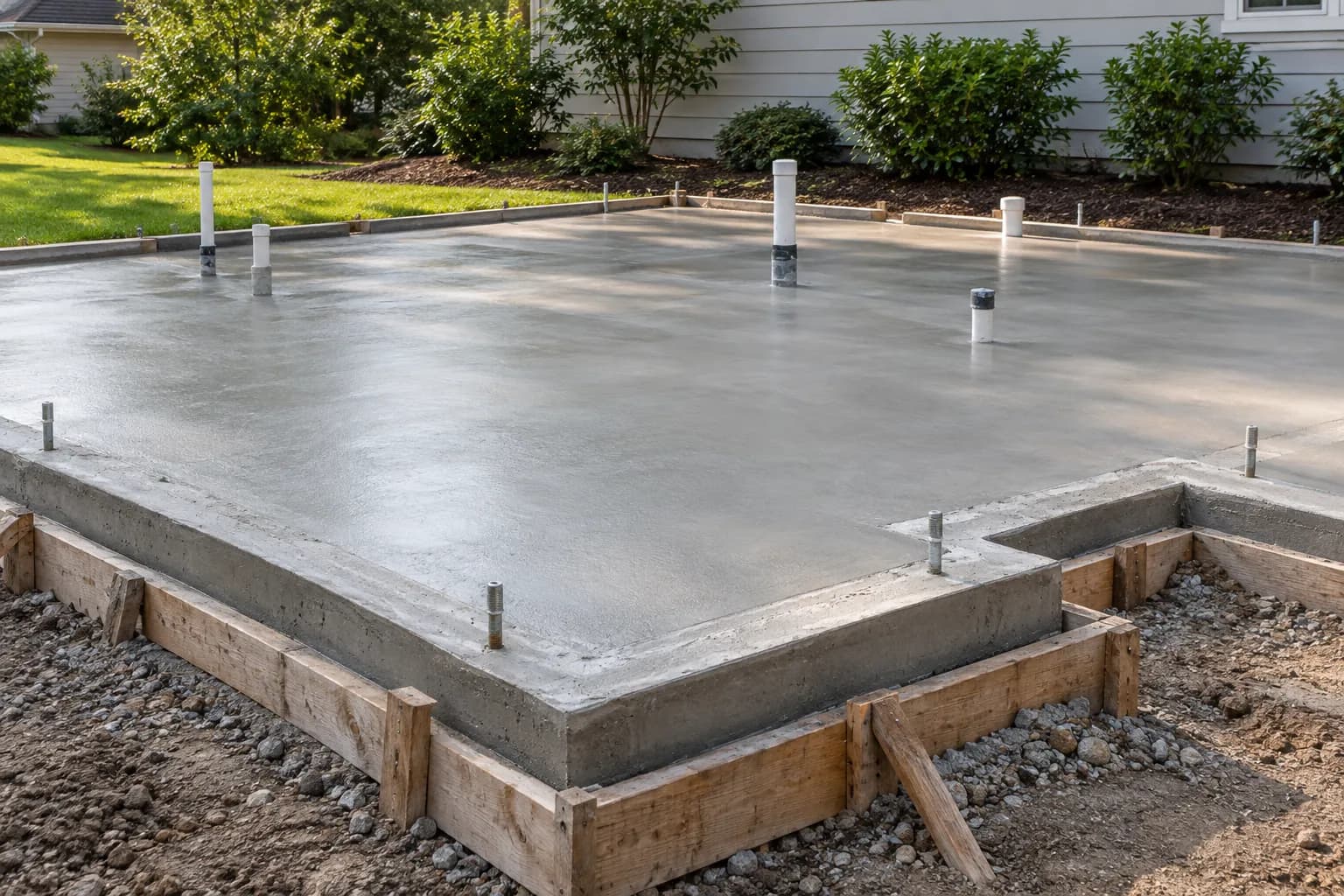
Cost Breakdown
| Component | Estimated Range |
|---|---|
| Ready-mix concrete (per yd³) | $130–$200 |
| Labor, base, forms & overhead | $6.31–$18.75/sq ft |
| Total installed (materials + labor + site prep) | $7.91–$22.45/sq ft |
Total reflects typical homeowner pricing, estimated from 28 Oregon DOT bid tabulations, Region 1 bid contracts (2023–26) adjusted for residential market rates. Ready-mix from national rates × local material index. Actual contractor quotes may vary.
The middle row is what local prices leave once the concrete is taken out, so besides crew labor it carries the gravel base, forms, reinforcement and contractor overhead. Crew labor alone, scaled from the national $3–8/sq ft by Portland, OR's cement mason wage ($36.05/hr, BLS May 2025), comes to about $3.90–$10.50/sq ft. How concrete labor is priced
Portland Market Conditions
Data source
28 public contracts
Oregon DOT bid tabulations, Region 1 (2023–26)
↗ sourceresidential: −31%
Climate
marine
Labor market
31% above avg
Best pour season
spring through fall
Dataset rank
21 of 30 markets
- —Portland's concrete market shares many characteristics with Seattle: high labor costs, a narrow outdoor work window due to persistent Pacific rain, and a construction sector that has been disrupted by the tech-sector boom in metro housing demand.
- —Portland cement masons earn wages 15–20% below Seattle levels, making it the more affordable of the two Pacific Northwest metros, though still well above the Sun Belt.
- —The wet marine climate (165+ rainy days per year) limits outdoor pours from October through May; most experienced contractors schedule all exterior flatwork during the June–September dry window, creating significant peak-season demand pressure.
- —The Portland basin's soils are predominantly Missoula Flood-deposited silts and clays in the flatlands, with glacially derived gravels in the west hills — flatland sites may require moisture conditioning before paving, while hillside lots require careful drainage planning.
- —Oregon's permitting requirements are more modest than California's (no Title 24 or SWPPP equivalent for residential flatwork), reducing overhead costs relative to the California metros.
- —Ready-mix pricing is competitive; multiple batch plants serve the metro with aggregate from the Columbia River corridor.
- —Decorative concrete work (stamped, stained, exposed aggregate) has a strong regional culture in Portland, and the dry summer months are ideal for these finishes.
Portland Site Conditions for Concrete
Freeze-thaw exposure
15.3 cycles/yr · Low
Specify air-entrained concrete (4.5-6.5% air) for exterior work.
SlabCalc Freeze-Thaw Index →Expansive soil risk
35/100 · Low
Standard slab-on-grade detailing is usually adequate. Confirm drainage moves water away from the slab edge.
SlabCalc Soil Risk Index →How Portland prices compare nationally: SlabCalc Concrete Cost Index.
Concrete vs. Alternatives — Foundation Cost Comparison
| Material (local estimates) | Installed Cost | Lifespan | Maintenance |
|---|---|---|---|
| Concrete (this market) | $7.91–$22.45/sq ft | 30–50 years | Seal every 3–5 yrs |
| Concrete block (CMU) | $4–$18/sq ft | 75–100 years | Monitor for water infiltration |
| ICF (insulated forms) | $9–$36/sq ft | 100+ years | Minimal |
| Pressure-treated crawl | $3–$15/sq ft | 30–50 years | Treat wood; monitor moisture |
Alternative costs are Portland-market estimates derived from typical cost relationships to local concrete prices.
Hiring Tips — Portland Concrete Foundation
- →Control joints every 10–12 feet prevent random cracking — a useful rule is joint spacing in feet equals slab thickness in inches.
- →Fall pours are generally fine through mid-October in temperate climates; avoid pouring when overnight lows will drop below 40°F within 24 hours.
- →Drainage planning for any slab or flatwork is non-negotiable in Portland's climate — 37+ inches of annual rainfall mean a slab without positive drainage to an outlet will have standing water problems within the first winter.
- →In Portland's high-cost labor market, get at least 3 competing bids — the spread between the lowest and highest quote often exceeds 40%.
- →Confirm the quote explicitly includes form stripping and waterproofing membrane — both are commonly omitted from first-draft proposals.
Related Guides
Estimate Your Foundation Cost in Portland
Enter your project dimensions to get an exact concrete volume estimate. Enter your ZIP to connect with local contractors.
Estimated concrete cost (materials + delivery) · For projects over 1 cubic yard, ready-mix is typically more economical and easier to work with.
734 bags × 80lb
16.30 cubic yards + delivery
600 sq ft × $6.31–$18.75/sq ft
Based on 2023–26 public bid data for this market. Actual contractor quotes may vary.
Hiring a contractor for this pour? See volume ↓
Includes 10% waste factor
Getting quotes from contractors? Use the Quote Calculator to understand every line item before you sign.
Concrete Foundation Cost FAQs — Portland, OR
Compare foundation pricing