

Corrosion-Induced Cracking in Concrete: Identification, Assessment & Repair Guide
Corrosion-induced cracking occurs when embedded steel reinforcement (rebar or wire mesh) rusts inside the concrete. Iron oxide (rust) occupies 2–6 times the volume of the original steel, generating expansive pressures up to 7,000 PSI that crack the concrete cover from the inside out. The unmistakable signature is linear cracking with rust-brown staining along the crack line, tracing the rebar layout beneath the surface. This is always a severity 3+ condition requiring professional attention.
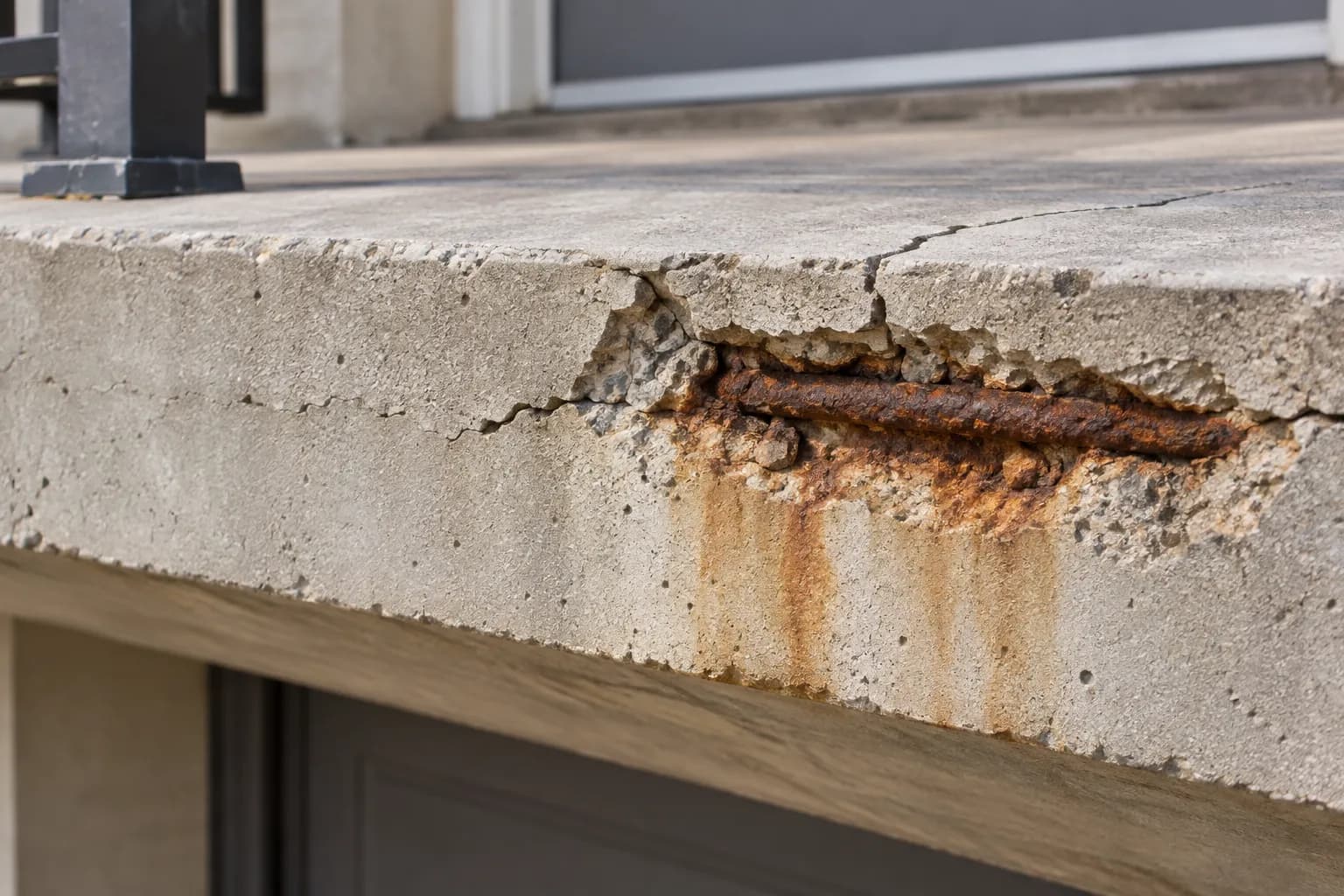
What Is Corrosion-Induced Cracking?
Corrosion-induced cracking is the fracturing of concrete from within, driven by the volumetric expansion of corroding steel reinforcement. It is the leading cause of structural deterioration in reinforced concrete worldwide, responsible for billions of dollars in infrastructure repair annually according to NACE International. Unlike surface-level shrinkage cracks or load-induced flexural cracks, corrosion cracking originates at the rebar depth and propagates outward to the surface — making it inherently more damaging and more difficult to repair.
The chemistry begins with the protective environment that concrete normally provides to embedded steel. Fresh concrete has a pore solution pH of 12.5 to 13.5, maintained by dissolved calcium hydroxide (Ca(OH)₂) produced during cement hydration. At this pH, steel forms a thin but extremely stable passive oxide film — primarily gamma-Fe₂O₃ — on its surface. This passive layer is only 5 to 10 nanometers thick but is thermodynamically stable in the alkaline environment, effectively preventing further oxidation. As long as this passive film remains intact, the steel does not corrode — even in the presence of moisture and oxygen.
When the passive layer is destroyed — by chloride ions or carbonation — electrochemical corrosion begins. The process follows the classic anodic-cathodic model. At the anode (the depassivated area), iron dissolves into solution: Fe → Fe²⁺ + 2e⁻. At the cathode (a passive area nearby), oxygen and water consume the electrons: O₂ + 2H₂O + 4e⁻ → 4OH⁻. The dissolved ferrous ions (Fe²⁺) migrate through the pore solution and react with hydroxyl ions and oxygen to form a series of corrosion products: ferrous hydroxide (Fe(OH)₂), ferric hydroxide (Fe(OH)₃), and ultimately hydrated ferric oxide (Fe₂O₃·nH₂O) and iron oxyhydroxides (alpha-FeOOH, gamma-FeOOH). These corrosion products occupy 2 to 6 times the volume of the original metallic iron, depending on the specific oxide formed and its degree of hydration. Red rust (Fe₂O₃·H₂O) has a volume ratio of approximately 6.4 relative to the parent iron.
This volume expansion generates enormous internal pressure at the steel-concrete interface. Research published in ACI 222R-19 ("Guide to Protection of Metals in Concrete Against Corrosion") documents tensile stresses on the order of 4,000 to 7,000 PSI at the rebar surface as corrosion products accumulate. Since concrete's tensile strength is only 300 to 600 PSI for typical mixes, cracking initiates long before the expansive pressure reaches its theoretical maximum. Once a crack forms, it creates a direct pathway for moisture, oxygen, and chlorides to reach the rebar — accelerating the corrosion rate and creating a self-reinforcing feedback loop. This is why corrosion-induced cracking is always progressive: it does not stabilize on its own and will continue to worsen until the root cause is addressed.
What Causes Rebar Corrosion?
Two primary mechanisms destroy the passive film on embedded steel: chloride attack and carbonation. A third factor — inadequate concrete cover — accelerates both mechanisms by reducing the distance that aggressive agents must penetrate to reach the steel.
Chloride-Induced Corrosion
Chloride-induced corrosion is the dominant mechanism in regions that use de-icing salts or in marine environments. Chloride ions (Cl⁻) are uniquely aggressive to the passive film because they are small enough to penetrate the oxide layer and displace the protective hydroxyl ions. At a critical concentration — the chloride threshold — the passive film breaks down locally, initiating pitting corrosion.
ACI 318-19 specifies maximum permissible chloride content in new concrete as a function of exposure: 0.06% by weight of cement for prestressed concrete, 0.15% for reinforced concrete exposed to chlorides, and 1.00% for dry-service reinforced concrete (ACI 318-19, Table 19.3.2.1). The generally accepted critical chloride threshold for depassivation of carbon steel rebar is 0.2% by weight of cement, or approximately 0.4% by weight of cite for typical mixes — though this value depends on pH, oxygen availability, and the specific steel metallurgy.
Chlorides reach the rebar through diffusion, capillary absorption, and permeation. The rate of chloride penetration is commonly modeled using Fick's second law of diffusion: C(x,t) = C₀[1 - erf(x / 2√(D·t))], where C₀ is the surface chloride concentration, x is the depth, t is time, and D is the apparent chloride diffusion coefficient. For ordinary Portland cement concrete with a w/c ratio of 0.45, D is typically 1 to 5 × 10⁻¹² m²/s. Supplementary cementitious materials (fly ash, slag, silica fume) can reduce D by a factor of 5 to 10, dramatically extending the time to chloride-induced corrosion.
The most common chloride sources are sodium chloride (NaCl) road salt, calcium chloride (CaCl₂) accelerators and de-icers, and seawater (approximately 3.5% NaCl by weight). CaCl₂ and MgCl₂ de-icers are significantly more aggressive than NaCl because their divalent cations react with cement hydration products, increasing concrete permeability and accelerating both chloride ingress and physical deterioration.
Carbonation
Carbonation is a slower but equally destructive process. Atmospheric carbon dioxide (CO₂) diffuses into the concrete pore network and reacts with calcium hydroxide in the pore solution: Ca(OH)₂ + CO₂ → CaCO₃ + H₂O. This reaction consumes the alkaline reserve, progressively lowering the pore solution pH from its initial value of 12.5–13.5 down to approximately 8.5–9.0. Below a pH of approximately 9.5, the passive film on carbon steel is no longer thermodynamically stable, and general (uniform) corrosion initiates across the entire rebar surface within the carbonated zone.
The carbonation front advances from the surface inward, roughly following a square-root-of-time relationship: d = K√t, where d is the carbonation depth in millimeters and K is a rate coefficient that depends on concrete permeability, CO₂ concentration, and relative humidity. Typical K values range from 1 to 5 mm/√year for normal-quality concrete. Carbonation proceeds fastest at 50 to 70% relative humidity — low enough for CO₂ diffusion through the pore network but high enough to provide the moisture needed for the chemical reaction. In perpetually wet concrete, carbonation is extremely slow because CO₂ diffusion through water-filled pores is 10,000 times slower than through air-filled pores.
For a concrete cover depth of 38 mm (1.5 inches), with K = 3 mm/√year, the carbonation front reaches the rebar in approximately 160 years — not a concern for most residential flatwork. However, poor-quality concrete with high porosity (w/c > 0.60) can have K values exceeding 10 mm/√year, reducing the time to depassivation to under 15 years. Carbonation is the primary corrosion mechanism in older structures, indoor parking garages with vehicle exhaust, and concrete made with high w/c ratios.
Inadequate Cover Depth
Concrete cover — the thickness of concrete between the outermost rebar and the nearest exposed surface — is the primary physical barrier against both chloride ingress and carbonation. ACI 318-19 Table 20.6.1.3 specifies minimum cover depths based on exposure:
- Cast against and permanently in contact with ground: 3 inches (75 mm)
- Exposed to weather or in contact with ground (No. 6 bars and larger): 2 inches (50 mm)
- Exposed to weather or in contact with ground (No. 5 bars and smaller): 1.5 inches (38 mm)
- Not exposed to weather or in contact with ground (slabs/walls): 0.75 inches (19 mm)
Every 1/4 inch of additional cover roughly doubles the time to corrosion initiation, because it increases the diffusion path length for chlorides and CO₂. Conversely, cover that is 1/4 inch less than specified — a common occurrence when rebar shifts during concrete placement — can halve the expected service life. This is why ACI 117-10 specifies cover tolerances of +3/8 inch / -1/4 inch for cast-in-place concrete and why pre-pour inspection of rebar placement and chairs is critical.
Poor Concrete Quality
High water-to-cement ratios produce concrete with greater capillary porosity, higher permeability, and faster chloride diffusion. ACI 318-19 Table 19.3.2.1 specifies maximum w/c ratios by exposure class: 0.40 for concrete exposed to chlorides (C2 exposure), 0.45 for concrete exposed to freezing and thawing with moisture (F2/F3). A w/c ratio of 0.50 versus 0.40 can increase the chloride diffusion coefficient by a factor of 3 to 5, dramatically shortening the time to corrosion initiation.
Inadequate curing also increases surface permeability. Concrete that is not moist-cured for at least 7 days develops a porous surface layer with significantly higher chloride diffusion rates than the interior — precisely the zone where low permeability matters most. ACI 308R recommends a minimum of 7 days of continuous moist curing for concrete in chloride environments.
How to Identify Corrosion-Induced Cracking
Corrosion cracking produces a distinctive pattern that experienced inspectors can identify at a glance. The following diagnostic comparison table distinguishes corrosion cracking from the two most commonly confused crack types.
| Feature | Corrosion Cracking | Shrinkage Cracking | ASR (Alkali-Silica Reaction) |
|---|---|---|---|
| Pattern | Linear, follows rebar grid | Map/web pattern | Map cracking, uniform |
| Key marker | Rust-brown staining | None | White/translucent gel exudation |
| Staining | Brown/orange along cracks | None | White deposits at cracks |
| Depth | At rebar level (1–3 inches deep) | Hairline; can be full depth (no offset) | Throughout section |
| Sound test | Hollow over delaminated areas | Solid | Solid or dull |
| Progression | Continuous, accelerating | Stops after curing complete | Slow, continuous over decades |
The hallmark diagnostic feature is the combination of linear cracking AND rust staining. Rust staining alone (without cracking) may indicate surface contamination from iron-bearing aggregate, metal furniture, or fertilizer — not rebar corrosion. Cracking alone (without rust staining) is more likely shrinkage, settlement, or overload. The two together, in a pattern that traces a regular grid or parallel lines at typical rebar spacing (12 to 18 inches), is definitive evidence of corrosion-induced cracking.
Delamination testing is equally important because delaminated areas represent concrete cover that has fully separated from the rebar but has not yet cracked through to the surface. These areas are invisible but structurally compromised. Two field methods detect delamination:
- Hammer sounding: Tap the concrete surface with a ball-peen hammer or masonry hammer. Sound concrete produces a sharp, ringing tone. Delaminated concrete produces a hollow, dull thud. Systematic tapping on a 6-inch grid reveals the full extent of delamination.
- Chain dragging: For large slab areas, drag a heavy chain (3/8-inch minimum) across the surface. The chain produces a distinctly different sound over delaminated zones — a rattling, hollow tone versus a clear ring. ASTM D4580 standardizes this method for bridge deck surveys.
In both cases, delamination typically extends significantly beyond the area of visible cracking and staining. A common rule of thumb is that the delaminated area is 2 to 3 times the area of visible surface damage.
Not sure what's causing your concrete damage? Upload a photo to the AI crack analyzer →
Severity Assessment
Corrosion-induced cracking is always severity 3 or higher because it involves active deterioration of the structural reinforcement. The severity depends on the extent of rebar section loss and the structural role of the affected element.
| Severity | Signs | Rebar Section Loss | Structural Risk | Action Required | Est. Cost |
|---|---|---|---|---|---|
| 3 | Rust staining + hairline cracks, no delamination | <10% | Low — adequate load capacity remains | Patch repair + surface sealing | $50–$150/sq ft |
| 4 | Cracking + active delamination, rebar may be visible | 10–25% | Moderate — reduced capacity, monitor closely | Full repair + cathodic protection or inhibitor | $80–$200/sq ft |
| 5 | Large spalls, exposed rebar with significant section loss | >25% | High — structural capacity compromised | Section replacement or structural reinforcement | $150–$400/sq ft |
Severity 3 represents the earliest stage at which corrosion cracking becomes visible at the surface. Intervention at this stage is the most cost-effective — the rebar is still structurally sound and can be treated in place. Severity 4 requires more extensive repair because delamination means larger areas of concrete must be removed, and the rebar may need supplemental reinforcement. Severity 5 is a structural emergency for load-bearing elements — the rebar has lost enough cross-section to reduce the member's capacity below its required design strength.
Full 1–5 severity scale explained →
How to Repair Corrosion Damage
Corrosion damage repair follows a consistent sequence regardless of severity: expose the rebar, evaluate section loss, treat or replace the steel, and reinstate the concrete cover. The critical addition is addressing the root cause — if the source of chlorides or carbonation is not mitigated, the new repair will corrode just as the original did.
Step-by-Step Repair Process
Step 1: Identify the corrosion pattern. Visually map all rust staining and cracking. Sound the entire affected area and at least 3 feet beyond visible damage in all directions. Mark delaminated zones. For structural elements, a corrosion specialist should perform a half-cell potential survey (ASTM C876) to map active corrosion zones that have not yet cracked — this reveals the full extent of the problem, not just the visible symptoms.
Step 2: Remove deteriorated concrete. Using a pneumatic chipping hammer or hydrodemolition, remove all delaminated and chloride-contaminated concrete around the affected rebar. Expose rebar a minimum of 6 inches beyond the last visible corrosion in all directions (per ICRI Guideline 310.1R). The removal boundary should be saw-cut to a minimum depth of 3/4 inch to create a clean, square edge that prevents feathering of the repair material.
Step 3: Evaluate rebar section loss. Measure the remaining rebar diameter at the most corroded point and compare to the nominal diameter. If section loss is less than 25%, the bar can be cleaned and treated in place. If section loss exceeds 25%, the corroded section must be cut out and new rebar spliced in with proper lap length per ACI 318-19 Section 25.5 — typically 40 to 60 bar diameters depending on bar size, concrete strength, and cover.
Step 4: Clean and treat the steel. Wire-brush or sandblast all exposed rebar to near-white metal per SSPC-SP 10 / NACE No. 2. This removes all corrosion products and exposes sound steel. Apply a zinc-rich primer or migrating corrosion inhibitor within 4 hours of cleaning — exposed steel in humid conditions begins re-corroding almost immediately. Zinc-rich primers (per SSPC Paint 20) provide galvanic protection to the rebar. Migrating corrosion inhibitors (typically calcium nitrite or amino-alcohol based) penetrate into the concrete and reform the passive layer.
Step 5: Reinstate concrete cover. Apply a polymer-modified repair mortar in lifts no greater than 1 inch per lift for overhead and vertical applications, or up to the full depth for horizontal surfaces. The repair material must have a similar modulus of elasticity and coefficient of thermal expansion to the parent concrete — significant mismatches cause ring cracking around the repair perimeter. Moist-cure for a minimum of 7 days per ACI 546R. After curing, apply a penetrating silane or siloxane sealer to the entire surrounding area to reduce future chloride or moisture ingress.
Repair Methods Comparison
| Method | Best Application | Addresses Root Cause? | Approx. Cost | Expected Durability |
|---|---|---|---|---|
| Patch repair (remove/treat/reinstate) | Localized damage, small areas | Partially — treats exposed rebar only | $50–$150/sq ft | 10–20 years if sealed |
| Migrating corrosion inhibitor (MCI) | Surface-applied to sound concrete around repairs | Yes — inhibits ongoing corrosion in untreated zones | $1–$3/sq ft | 5–10 years (reapply) |
| Cathodic protection (impressed current) | Large structures, bridges, parking decks | Yes — stops corrosion electrochemically | $5–$15/sq ft | 20+ years with maintenance |
| Cathodic protection (sacrificial anode) | Localized repairs, small structures | Yes — localized galvanic protection | $200–$500/anode | 10–15 years per anode |
| Electrochemical chloride extraction (ECE) | Chloride-contaminated structures | Yes — physically removes chlorides from concrete | $10–$25/sq ft | Permanent if sealed |
| Full section replacement | Severe damage, structural deficiency | Yes — entirely new concrete and rebar | $8–$15/sq ft (flatwork) | Life of new concrete |
Cathodic protection deserves special mention. Impressed current cathodic protection (ICCP) applies a small direct current (typically 5 to 20 mA/m² of steel surface area) from an external anode to the rebar, forcing the entire rebar mat into a cathodic (non-corroding) state. ICCP is the only repair method proven to stop corrosion in chloride-contaminated concrete without removing the chlorides. It is standard practice for bridge decks and parking structures per NACE SP0290.
Sacrificial anode systems embed zinc or zinc-aluminum anodes directly in the repair mortar adjacent to the rebar. The anode corrodes preferentially, protecting the steel. These are simpler than ICCP (no external power supply) but provide protection over a limited radius — typically 6 to 12 inches from each anode.
DIY vs. Professional
Corrosion-induced cracking is not a DIY repair under any circumstances. Even the diagnostic phase — determining whether cracking is actually from corrosion, mapping the full extent of delamination, and evaluating rebar section loss — requires tools and expertise beyond homeowner capabilities. Half-cell potential surveys require specialized equipment (a copper-copper sulfate reference electrode and high-impedance voltmeter). Rebar section loss evaluation requires concrete removal. Repair mortar application for corrosion repairs requires specific surface preparation, material selection, and curing protocols that differ significantly from cosmetic patching.
The homeowner's role is limited but important: recognize the visual signs early (linear cracking with rust staining), avoid delay, and engage a qualified contractor. Early intervention at severity 3 costs a fraction of severity 5 repairs and prevents structural compromise.
When hiring a contractor, look for ACI-certified concrete repair technicians, NACE-certified corrosion specialists (for cathodic protection work), or ICRI member contractors. Ask for references on corrosion repair projects specifically — general concrete contractors may not have the specialized knowledge to address root-cause corrosion issues.
Prevention Strategies
Prevention is dramatically more cost-effective than repair. The cost of specifying adequate cover, low-permeability concrete, and a surface sealer during new construction is measured in cents per square foot. The cost of corrosion repair is measured in tens to hundreds of dollars per square foot.
For New Construction
Adequate cover depth. Specify and verify cover depths per ACI 318-19 Table 20.6.1.3. For residential flatwork exposed to weather, the minimum is 1.5 inches. For driveways and slabs subject to de-icing salt exposure, 2 inches is prudent even though not code-required. Use plastic rebar chairs (not brick fragments or stones) at maximum 4-foot spacing to maintain cover during placement. Verify cover before and during the pour.
Low-permeability concrete. Specify w/c ratio no greater than 0.45 for any concrete exposed to chlorides (ACI 318-19 Table 19.3.2.1 requires 0.40 for C2 exposure). Incorporate supplementary cementitious materials — 25 to 35% fly ash or 40 to 60% slag cement — which react with calcium hydroxide to produce additional C-S-H gel, refining the pore structure and reducing chloride diffusion by 5 to 10 times. Silica fume at 5 to 8% by weight of cement produces the lowest permeability of any common SCM but requires careful mix design and placement.
Corrosion-resistant reinforcement. For high-chloride environments, consider alternatives to carbon steel rebar:
- Epoxy-coated rebar (ASTM A775): a 7 to 12 mil fusion-bonded epoxy coating that acts as a barrier. Effective when intact, but corrosion can initiate at coating holidays (nicks, bends, cut ends). Handle carefully to minimize coating damage.
- Galvanized rebar (ASTM A767): hot-dip zinc coating provides both barrier protection and galvanic (sacrificial) protection. The zinc corrodes preferentially, protecting the underlying steel. Zinc's corrosion products are not expansive and do not crack concrete.
- Stainless steel rebar (ASTM A955): chloride threshold approximately 10 times higher than carbon steel. Effectively immune to corrosion in all but the most extreme marine environments. Cost is 4 to 8 times carbon steel, limiting use to critical applications.
- GFRP rebar (ASTM D7957): glass fiber reinforced polymer bars are completely immune to corrosion. Lower modulus of elasticity than steel (6,000 vs. 29,000 ksi) requires design adjustments for deflection.
For more on reinforcement options: When to use rebar in a concrete slab → and Rebar vs. wire mesh vs. fiber →.
Proper curing. Moist-cure for a minimum of 7 days (ACI 308R). Adequate curing reduces surface permeability by promoting complete hydration of the cement paste in the cover zone — exactly where low permeability matters most.
For Existing Concrete
Penetrating sealers. Silane and siloxane sealers penetrate into the concrete pore structure and form a hydrophobic barrier that repels water and dissolved chlorides without changing the surface appearance. Effective penetration depth is typically 1/8 to 1/4 inch. Reapply every 5 to 10 years depending on traffic and exposure. These are the single most cost-effective protection measure for existing flatwork — application costs $0.50 to $1.50 per square foot.
Avoid de-icing salts. Sodium chloride, calcium chloride, and magnesium chloride de-icers all introduce chlorides that accelerate rebar corrosion. For residential driveways and sidewalks, use sand for traction, calcium magnesium acetate (CMA) as a non-corrosive de-icer, or heated driveway systems. If salt must be used, apply sparingly and wash the surface in spring to reduce residual chloride concentration.
Migrating corrosion inhibitors. Surface-applied MCIs (typically amino-alcohol or amine-carboxylate formulations) penetrate through the concrete cover and adsorb onto the rebar surface, reinforcing the passive layer. These are most effective as a preventive measure on sound concrete in chloride environments. Application costs $1 to $3 per square foot with reapplication every 5 to 10 years.
Corrosion in Different Environments
Corrosion risk varies dramatically by environment. The same concrete mix that provides 75+ years of service in an arid inland climate may deteriorate in 20 years in a marine splash zone.
Marine structures face the highest corrosion risk. Seawater contains approximately 19,400 ppm chloride — far exceeding the corrosion threshold. The splash and tidal zones are worst because they provide the cyclic wetting and drying that maximizes both chloride accumulation and oxygen availability. ACI 318-19 requires 3 inches of cover and w/c no greater than 0.40 for marine exposure. ACI 357R provides additional guidance for offshore structures.
Parking structures are the second most vulnerable category. Vehicles track road salt and salt-laden slush onto every level. Chloride concentrations on parking deck surfaces routinely exceed 10 lb/yd³ of concrete — over 5 times the corrosion threshold — within 10 to 15 years of service. The American Society of Civil Engineers (ASCE) Infrastructure Report Card consistently identifies parking structure deterioration as a significant concern in northern states.
Bridge decks experience direct de-icing salt application combined with high traffic abrasion that progressively wears down the concrete cover. FHWA estimates that corrosion of reinforcing steel is the primary deterioration mechanism in approximately 15% of the nation's structurally deficient bridges. The annual direct cost of bridge corrosion in the United States exceeds $8 billion according to NACE International's "Cost of Corrosion" study.
Coastal residential flatwork — sidewalks, driveways, and patios within 1,000 feet of the ocean — experiences airborne chloride deposition that, while far lower than direct seawater exposure, is sufficient to initiate corrosion over a 20 to 30 year period in permeable concrete. Penetrating sealers are strongly recommended for all reinforced concrete in coastal zones.
Inland residential flatwork has the lowest corrosion risk. In regions that do not use de-icing salts, the primary corrosion mechanism is carbonation — a very slow process that typically does not reach the rebar within the 30 to 50 year service life of residential flatwork. In northern states that use road salt, driveways and sidewalks adjacent to salted roads are at moderate risk and benefit from sealer application.
Cost Estimates
| Repair Type | Typical Cost Range | When Appropriate |
|---|---|---|
| Corrosion assessment (specialist) | $500–$2,000 | Any suspected corrosion — baseline assessment |
| Patch repair (localized) | $50–$150/sq ft | Severity 3, isolated areas |
| Full repair + inhibitor | $80–$200/sq ft | Severity 4, moderate delamination |
| Cathodic protection (impressed current) | $5–$15/sq ft | Large structures, ongoing chloride exposure |
| Cathodic protection (sacrificial anode) | $200–$500/anode | Localized repairs |
| Electrochemical chloride extraction | $10–$25/sq ft | Chloride-contaminated but structurally sound |
| Full section replacement (flatwork) | $8–$15/sq ft | Severity 5, extensive damage |
| Full section replacement (structural) | $200–$500+/sq ft | Structural elements with >25% rebar section loss |
| Preventive sealer application | $0.50–$1.50/sq ft | All exposed reinforced concrete |
These costs reflect 2024–2025 national averages and vary significantly by region, access difficulty, and project scale. Urban areas and structural elements (elevated slabs, columns, beams) command premium pricing due to access requirements, shoring, and engineering oversight.
Key Takeaways
- Rust staining combined with linear cracking is the definitive sign of rebar corrosion — act immediately to prevent escalation from severity 3 to severity 5.
- Corrosion-induced cracking is always progressive. It does not stabilize on its own. Delay increases both repair cost and structural risk.
- All corrosion repairs require professional execution — from diagnosis (delamination mapping, half-cell surveys) through repair (rebar evaluation, mortar reinstatement) to root-cause mitigation.
- Address the root cause, not just the symptom. Patching corroded areas without mitigating chloride ingress or carbonation results in re-corrosion of the repair within 5 to 10 years.
- Prevention costs cents per square foot; repair costs tens to hundreds of dollars per square foot. Adequate cover depth, low-permeability concrete, and periodic sealer application provide decades of protection.
- Early intervention at severity 3 costs 3 to 5 times less than repair at severity 5 — and avoids the structural capacity questions that severity 5 raises.
- For new construction, specify corrosion protection explicitly — cover depth, w/c ratio, SCMs, and sealer — rather than relying on default practices.
Next Steps
- Concrete damage assessment guide → — Full severity scale and damage type identification
- When to use rebar in a concrete slab → — Reinforcement decisions that affect long-term durability
- Rebar vs. wire mesh vs. fiber → — Compare reinforcement types including corrosion-resistant options
- How to repair concrete cracks → — General crack repair methods and when each applies
- Why concrete cracks → — All crack types compared
- Concrete slab cost calculator → — Estimate costs for replacement if repair is not viable