
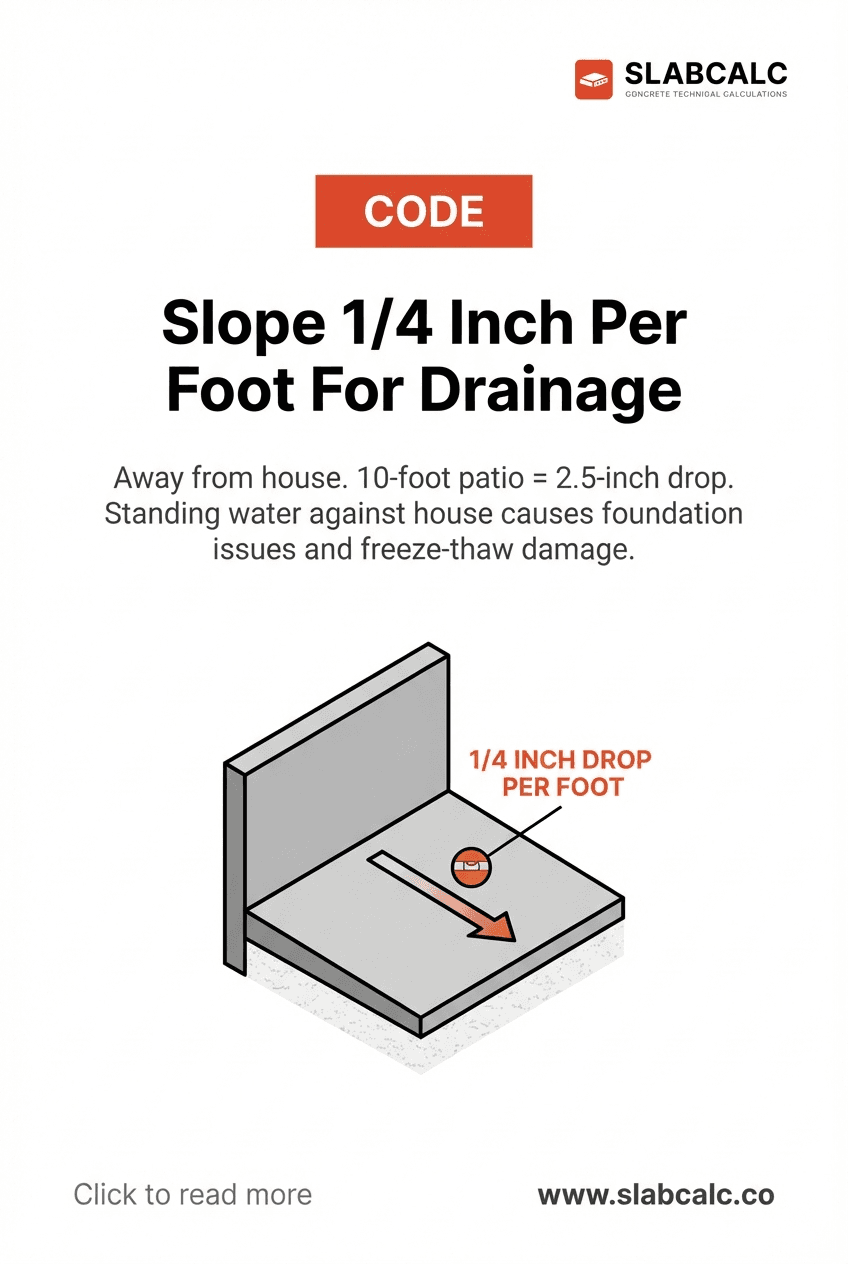
Slope 1/4 Inch Per Foot For Drainage
The Code Requirement
The IRC (International Residential Code) Section R401.3 and ACI 330 (Guide for the Design and Construction of Concrete Parking Lots) both mandate a minimum slope of 1/4 inch of vertical drop for every 1 foot of horizontal distance. This translates to a 2% grade—steep enough to shed water but gradual enough that it's barely noticeable underfoot.
Most local building departments enforce this as a standard condition for patio permits. If your inspector finds standing water pooling on your patio during the final walkthrough, the project fails inspection and you'll be required to remove and re-pour the slab.
Why This Specific Slope?
Water doesn't evaporate fast enough to protect concrete. Even a 1/8-inch slope—half the code requirement—leaves standing water after rain. That water:
- Infiltrates microscopic cracks in the concrete
- Freezes in winter, expanding and cracking the slab (freeze-thaw damage)
- Wicks moisture into the soil beneath, destabilizing the base
- Migrates toward your house foundation, causing seepage into basements and crawl spaces
A 10-foot patio sloped at 1/4 inch per foot requires a 2.5-inch total drop from the high side (nearest the house) to the low side (away from the house). This seems small, but it's the mathematical threshold where gravity becomes strong enough to clear water reliably within 24-48 hours of rain.
Calculating Your Slope
The math is straightforward:
Drop (inches) = Distance (feet) × 0.25
- 8-foot patio = 2 inches drop
- 12-foot patio = 3 inches drop
- 16-foot patio = 4 inches drop
- 20-foot patio = 5 inches drop
Measure the distance from your house to the slab's far edge, multiply by 0.25, and that's your required elevation difference. Use a 4-foot level and a shim block to verify slope during layout. A laser level makes this easier—set it at the house edge, measure the height difference 10 feet away, and adjust until you hit exactly 2.5 inches.
Common Violations and Consequences
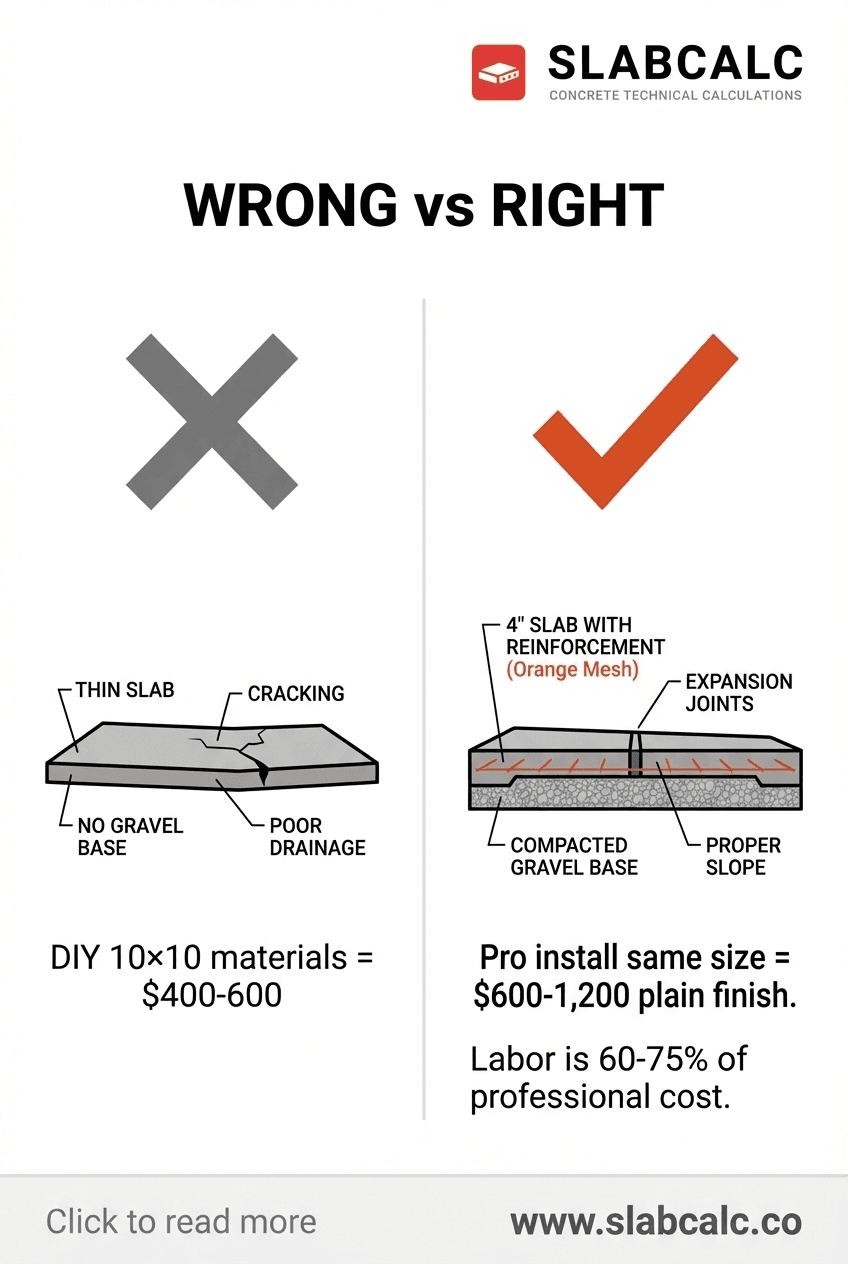
Flat slabs (zero slope) are the most common DIY mistake. They look intentional and seem level underfoot, but they fail within 2-3 years as water damage accumulates.
Slope toward the house is the worst error. Water pools against your foundation, causing concrete efflorescence, mold growth, and structural damage to rim joists and siding.
Insufficient slope (1/8 inch per foot) doesn't drain fast enough in clay-heavy soils or areas with heavy rainfall.
Installation Tips
- Slope the entire slab uniformly, not just the edges
- Slope away from all sides of the house—not just one direction
- For L-shaped or irregular patios, slope toward the lowest point, away from structures
- After pouring and finishing, confirm slope before concrete cures using a hose test—water should flow visibly toward the low end
Getting slope right during the pour prevents costly repairs later. It's the difference between a 25-year patio and one that fails in 5.