
Drainage Slope Is Required
Your Inspection Gets Rejected—Before Concrete Arrives
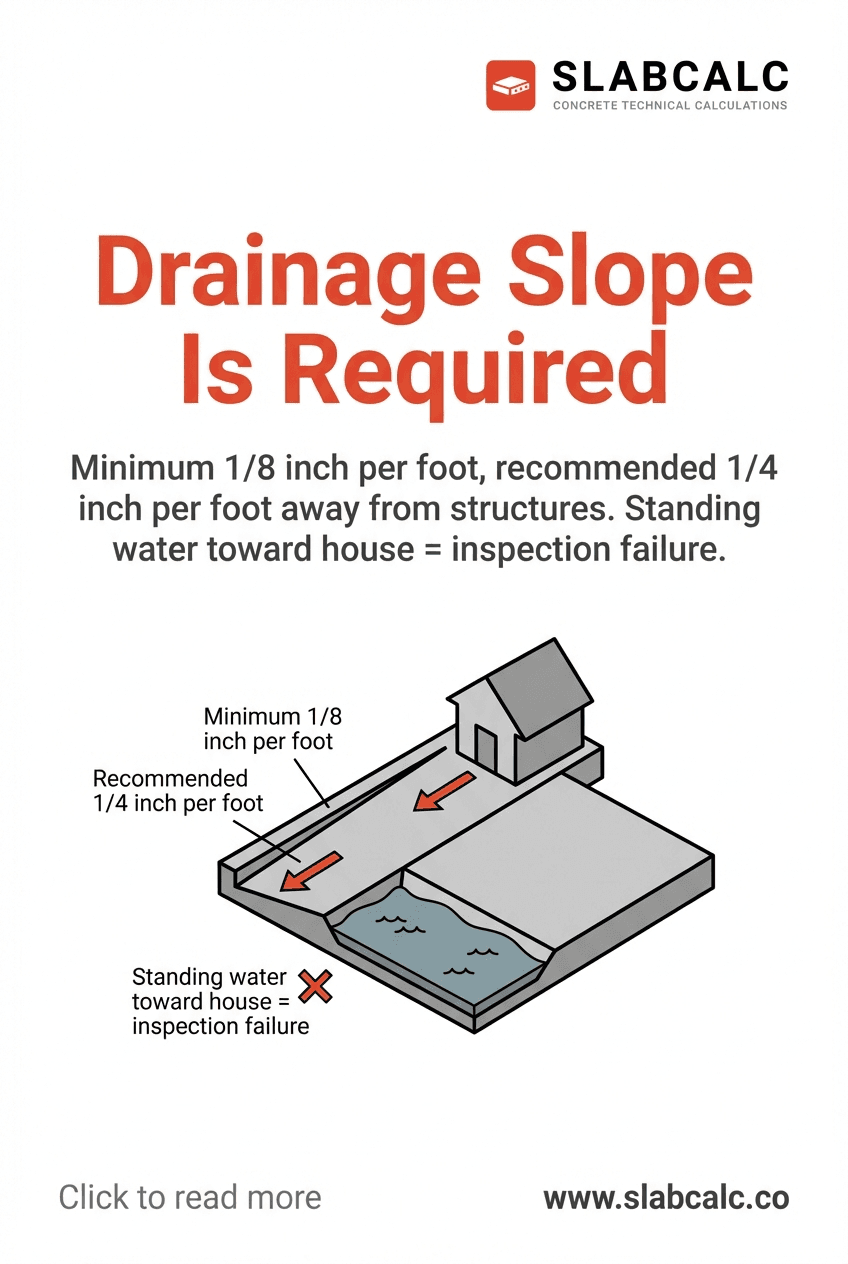
Standing water on your slab inspection means an automatic inspection failure. The inspector will not approve the pour. You cannot proceed until the slope is corrected. This means demolishing and re-forming already-prepared sections—a costly delay that costs hundreds in rework labor before a single cubic yard of concrete touches your site.
The inspector isn't being picky. Water pooling on a slab causes foundation damage, basement flooding, frost heave in freeze-thaw climates, and accelerated concrete deterioration. Codes exist to protect your home and your investment. Slope requirements are non-negotiable.
Why Slope Gets Missed (The Root Cause)
Most homeowners and DIYers underestimate how shallow proper slope actually is. A 1/8 inch per foot slope—the absolute minimum—sounds invisible to the eye. It's not.
Here's the math: A 10-foot-wide patio needs 1.25 inches of drop from back to front (10 feet × 1/8 inch = 1.25 inches). A 20-foot driveway needs 2.5 inches of drop. That is noticeable, but it's easy to eyeball incorrectly.
Many DIYers either:
- Build a level slab (slope = zero) because they don't understand the requirement
- Create a slope that's too shallow to drain effectively
- Slope toward the house instead of away from it—the opposite of what's needed
The inspector identifies this before the concrete cures. If caught too late, you'll remove set concrete, rebuild forms, and pour again.
How to Identify Slope Problems Before Inspection
Use a string line and level—not your eye. Here's the process:
- Measure the distance from the high point to the low point of your slab (in feet).
- Calculate required drop: Distance (feet) × 1/8 inch = minimum drop.
- String a line from the high point (usually at the house or back of the slab).
- Measure the vertical gap between the string and the ground at the low point.
- Compare: Your actual drop must be at least as large as your calculated minimum. Better: aim for 1/4 inch per foot (twice the minimum) for reliable drainage.
Example: A 12-foot patio needs at least 1.5 inches of drop. Measure the height difference with a level and tape. If it's only 0.5 inches, your slope is inadequate.
Pre-Inspection Prevention Checklist
✓ Forms are built with correct slope—verify with string and level before the pour
✓ Slope runs away from structures—water must drain toward the street or low point, never toward your foundation
✓ No low spots—use a level to confirm the slope is consistent (not wavy)
✓ Subgrade is compacted evenly—soft spots create unintended pools
✓ Gravel base is level under sloped forms—base preparation supports the slope
Get this right at the forms stage. Once concrete sets, you're paying to remove it.